
A little sneaky
You’re making it sound worse than it was.

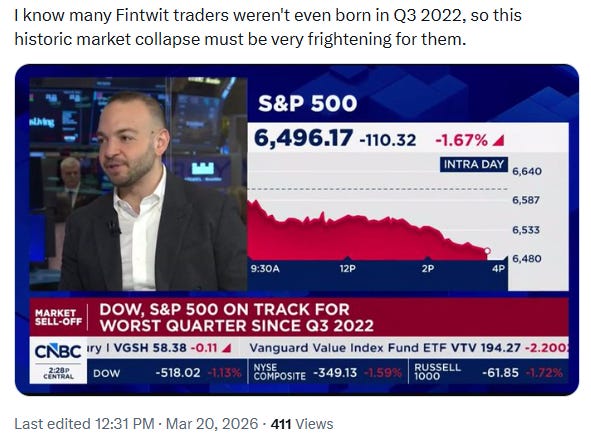
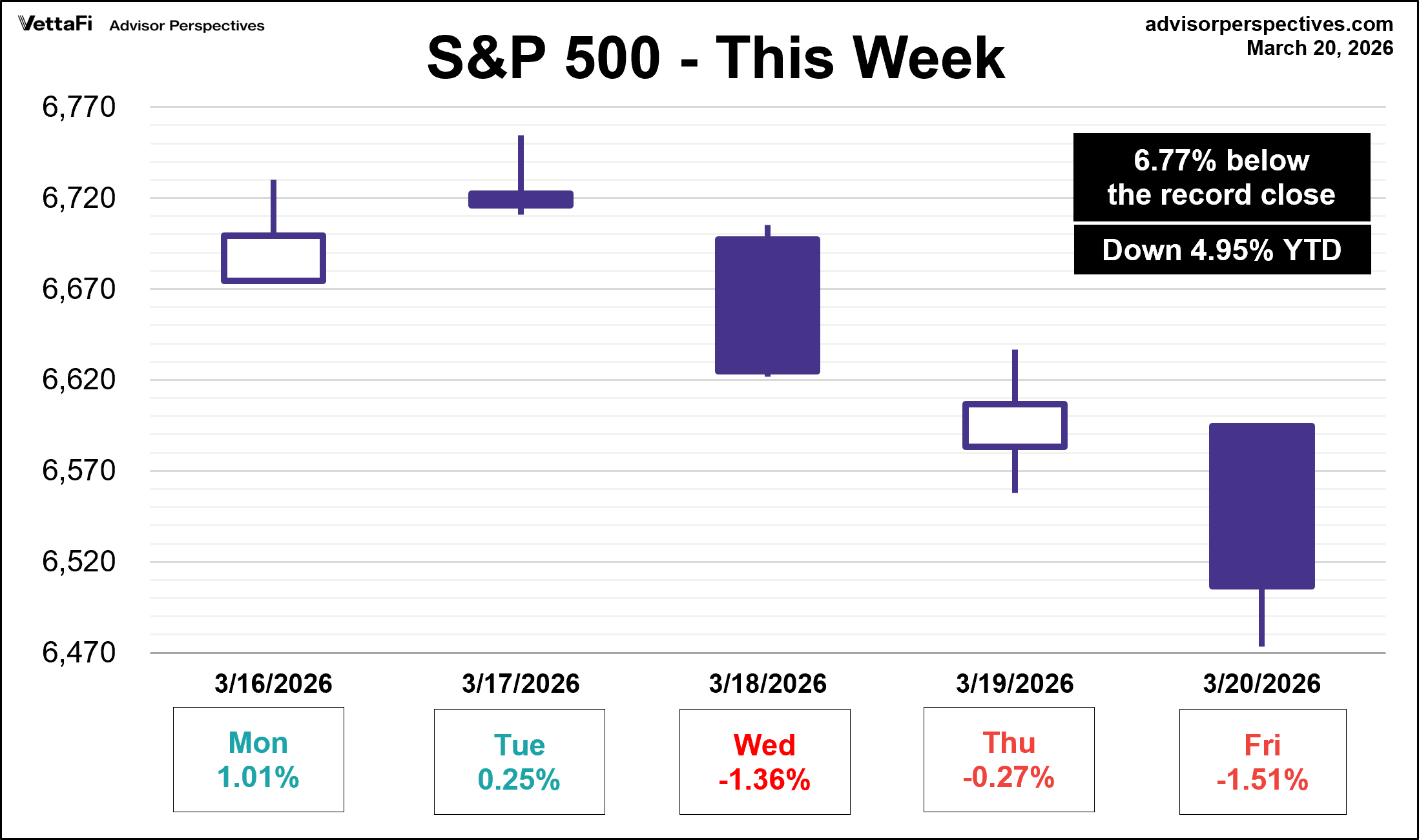
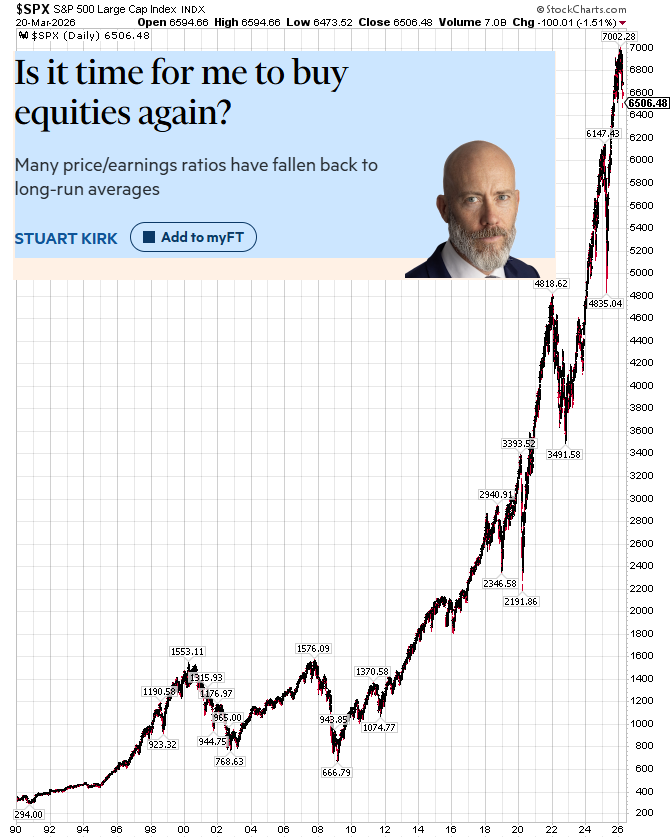
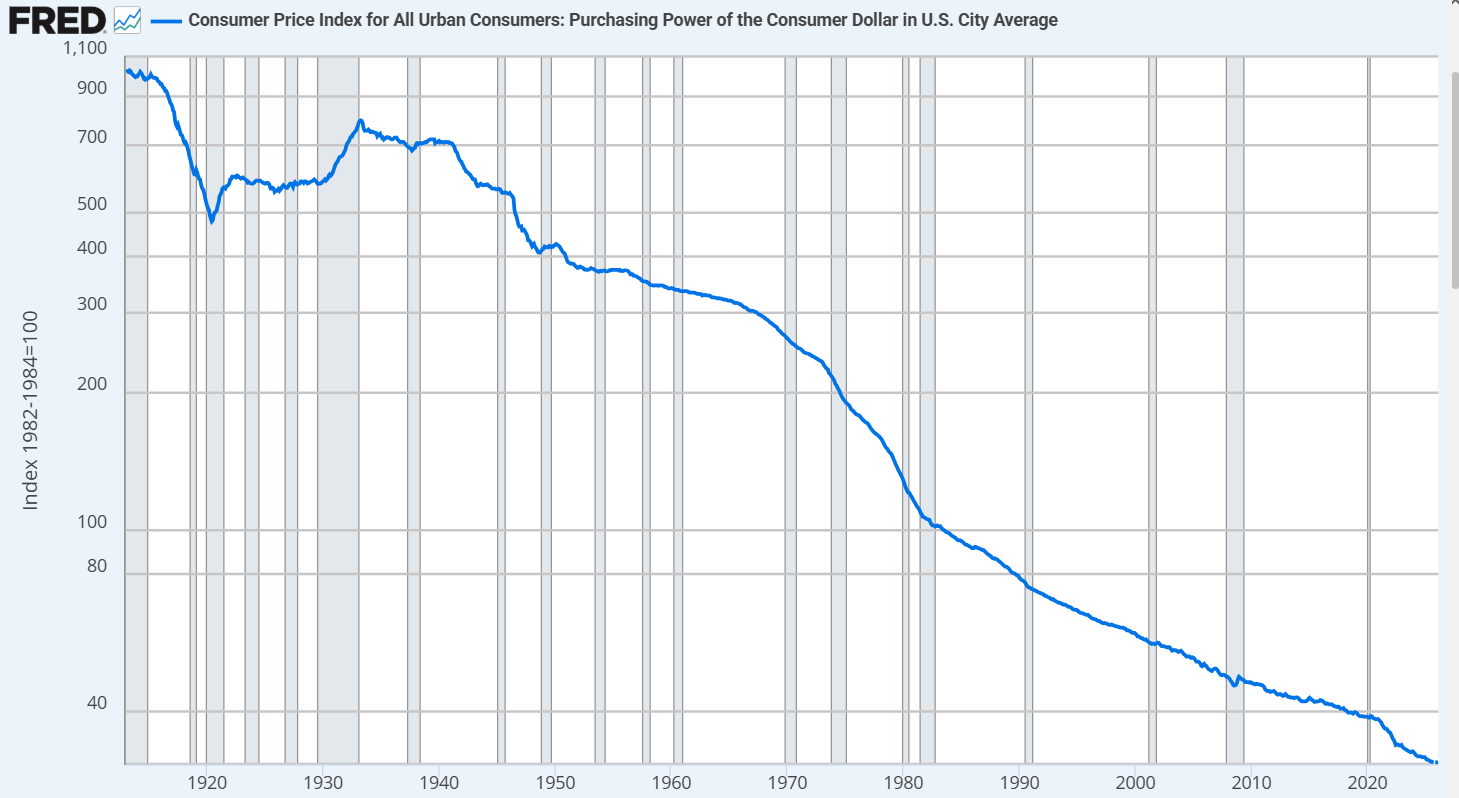
Time to break out this trusty chart again…
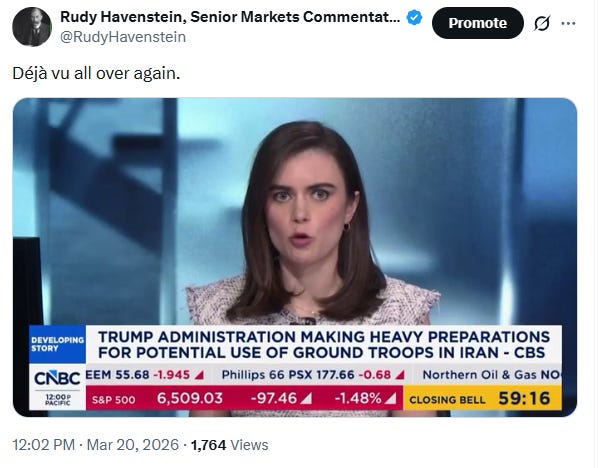
I have a lot of friends who are very pro-Trump, and a few who are very anti-Trump. In spite of today’s insane political climate, where I’ve seen many friendships broken over politics, I have largely been able to to keep both groups as friends these past 10+ years. I’m pro-America, anti-party (like George Washington1) and slightly odd, which is why I generally write-in Ron Paul. I think my hardcore pro-Trump friends know I’m not a communist, and view me simply as moderately brain-damaged2, but OK in general.
I completely broke with the Republican Party after the Iraq fiasco, a truly unnecessary and tragic war (which I think Iran was the winner of). People automatically assume that if you are anti-GOP, you are pro-Democrat. I am not. I loathe both parties. I trust neither.
To see what is going on in Iran now is very disheartening to me. We learn nothing from history. I think it’s a terrible mistake.
I have been including eclectic Iran-related items in my posts lately for obvious reasons. This may not continue for long, as it seems Trump late Friday declared the war almost over, for the tenth time. If you are strongly pro-Trump and pro-war and my comments bug you, that’s fine. I understand many don’t share my naive views. I talk to such people all the time.
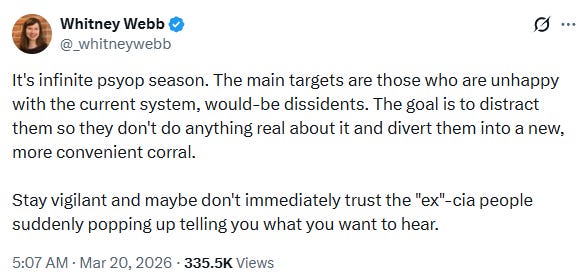
Good advice, which I have to keep in mind, as, for example, when people note Joe Kent’s ties to Peter Thiel.
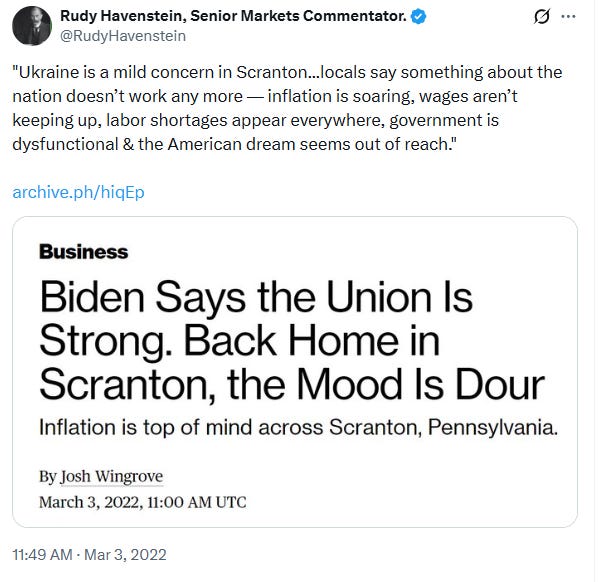
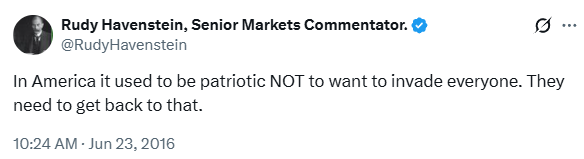
I think of these wise words too:
Observe good faith and justice towards all nations; cultivate peace and harmony with all.
Religion and morality enjoin this conduct; and can it be, that good policy does not equally enjoin it - It will be worthy of a free, enlightened, and at no distant period, a great nation, to give to mankind the magnanimous and too novel example of a people always guided by an exalted justice and benevolence. Who can doubt that, in the course of time and things, the fruits of such a plan would richly repay any temporary advantages which might be lost by a steady adherence to it ? Can it be that Providence has not connected the permanent felicity of a nation with its virtue ? The experiment, at least, is recommended by every sentiment which ennobles human nature. Alas! is it rendered impossible by its vices?
In the execution of such a plan, nothing is more essential than that permanent, inveterate antipathies against particular nations, and passionate attachments for others, should be excluded; and that, in place of them, just and amicable feelings towards all should be cultivated. The nation which indulges towards another a habitual hatred or a habitual fondness is in some degree a slave. It is a slave to its animosity or to its affection, either of which is sufficient to lead it astray from its duty and its interest. Antipathy in one nation against another disposes each more readily to offer insult and injury, to lay hold of slight causes of umbrage, and to be haughty and intractable, when accidental or trifling occasions of dispute occur. Hence, frequent collisions, obstinate, envenomed, and bloody contests. The nation, prompted by ill-will and resentment, sometimes impels to war the government, contrary to the best calculations of policy. The government sometimes participates in the national propensity, and adopts through passion what reason would reject; at other times it makes the animosity of the nation subservient to projects of hostility instigated by pride, ambition, and other sinister and pernicious motives. The peace often, sometimes perhaps the liberty, of nations, has been the victim.
So likewise, a passionate attachment of one nation for another produces a variety of evils. Sympathy for the favorite nation, facilitating the illusion of an imaginary common interest in cases where no real common interest exists, and infusing into one the enmities of the other, betrays the former into a participation in the quarrels and wars of the latter without adequate inducement or justification. It leads also to concessions to the favorite nation of privileges denied to others which is apt doubly to injure the nation making the concessions; by unnecessarily parting with what ought to have been retained, and by exciting jealousy, ill-will, and a disposition to retaliate, in the parties from whom equal privileges are withheld. And it gives to ambitious, corrupted, or deluded citizens (who devote themselves to the favorite nation), facility to betray or sacrifice the interests of their own country, without odium, sometimes even with popularity; gilding, with the appearances of a virtuous sense of obligation, a commendable deference for public opinion, or a laudable zeal for public good, the base or foolish compliances of ambition, corruption, or infatuation.
As avenues to foreign influence in innumerable ways, such attachments are particularly alarming to the truly enlightened and independent patriot. How many opportunities do they afford to tamper with domestic factions, to practice the arts of seduction, to mislead public opinion, to influence or awe the public councils. Such an attachment of a small or weak towards a great and powerful nation dooms the former to be the satellite of the latter.
Against the insidious wiles of foreign influence (I conjure you to believe me, fellow-citizens) the jealousy of a free people ought to be constantly awake, since history and experience prove that foreign influence is one of the most baneful foes of republican government. But that jealousy to be useful must be impartial; else it becomes the instrument of the very influence to be avoided, instead of a defense against it. Excessive partiality for one foreign nation and excessive dislike of another cause those whom they actuate to see danger only on one side, and serve to veil and even second the arts of influence on the other. Real patriots who may resist the intrigues of the favorite are liable to become suspected and odious, while its tools and dupes usurp the applause and confidence of the people, to surrender their interests.
Director of National Intelligence
National Counterterrorism CenterPresident Trump,
After much reflection, I have decided to resign from my position as Director of the National Counterterrorism Center, effective today.
I cannot in good conscience support the ongoing war in Iran. Iran posed no imminent threat to our nation, and it is clear that we started this war due to pressure from Israel and its powerful American lobby.
I support the values and the foreign policies that you campaigned on in 2016, 2020, 2024, which you enacted in your first term. Until June of 2025, you understood that the wars in the Middle East were a trap that robbed America of the precious lives of our patriots and depleted the wealth and prosperity of our nation.
In your first administration, you understood better than any modern President how to decisively apply military power without getting us drawn into never-ending wars. You demonstrated this by killing Qasam Solamani and by defeating ISIS.
Early in this administration, high-ranking Israeli officials and influential members of the American media deployed a misinformation campaign that wholly undermined your America First platform and sowed pro-war sentiments to encourage a war with Iran. This echo chamber was used to deceive you into believing that Iran posed an imminent threat to the United States, and that should you strike now, there was a clear path to a swift victory. This was a lie and is the same tactic the Israelis used to draw us into the disastrous Iraq war that cost our nation the lives of thousands of our best men and women. We cannot make this mistake again.
As a veteran who deployed to combat 11 times and as a Gold Star husband who lost my beloved wife Shannon in a war manufactured by Israel, I cannot support sending the next generation off to fight and die in a war that serves no benefit to the American people nor justifies the cost of American lives.
I pray that you will reflect upon what we are doing in Iran, and who we are doing it for. The time for bold action is now. You can reverse course and chart a new path for our nation, or you can allow us to slip further toward decline and chaos. You hold the cards.
It was an honor to serve in your administration and to serve our great nation.
Joseph Kent
Director, National Counterterrorism Center
“Colin Powell is someone who I have a lot of respect for, for the way he fought in Vietnam, his leadership in Desert Storm. But then the way that he was part of lying to get us into the Iraq war, and then staying on and continuing those lies - knowing full well, having all the experiences of being a guy on the ground in a futile war that was - basically we we were deployed under false pretenses. He had all that knowledge, and because he wanted to be loyal to I think the president, and I think he wanted to be loyal to what what he felt was the government, that would eventually get it right. He didn’t step out and say we shouldn’t be doing this. And I just remember reflecting on that, and I said to myself at the time - and this might seem, you know, silly and idealistic - but said to myself at the time, if it’s ever my turn, if it’s ever my generation’s turn, I’m going to do everything that I can to make sure this doesn’t happen to the next generation.
So - a real breaking point for me - I did the best I could for a couple weeks as this war started, from the inside to try and find off-ramps, to try and provide information, to see what I could do from the inside. But watching the casualties roll in - and I don’t want to use anyone’s loss as as a political talking point, but for me personally - watching more casualties come in, I just couldn’t stand by as both a veteran and as a gold star husband, and say, I’m just going to continue to to soldier on in this.
It’s time to try something different. I know this path that we’re on. It doesn’t work. I’ve seen enough data. It’s time to do something different.”
Note that in Kent’s full interview with Tucker Carlson, he remains very complimentary of President Trump.
“This is not the first time the United States has entered into this kind of war against the wishes of its own population and in clear contravention of its own interests, against its interests. This isn’t good for us. No one has made the case that it’s good for us. And increasingly, as the days pass, it becomes obvious to everyone why it’s not good for us.”
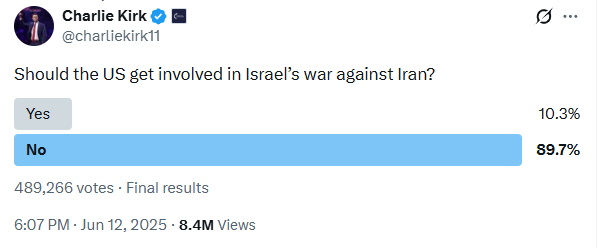
This Charlie Kirk clip is from a few days before the U.S. bombed Iran in 2025:
The platoon leader, the latest one to lead the company advance, had called a short break, and the men had their helmets off, drinking from their canteens and eating, or licking, melted chocolate out of candy bar wrappers. The radioman, a wiry black kid who as usual looked too thin to be lugging a seventy-five-pound radio, was slouched back on his radio pack with the weight off his shoulders.
As I thought about the day, it came to me to ask him something I had begun to ask myself that morning: “By any chance, do you ever feel like the redcoats?”
Without hesitating a beat he said, in a drawl, “I been thinking that…all…day.”
You couldn’t miss it if you’d gone to grade school in America. Foreign troops far from home, wearing helmets and uniforms and carrying heavy equipment, walking along dikes in formation and getting shot at every half hour mostly by ragged local irregulars firing from tree lines that bordered their homes.
- Daniel Ellsberg, Secrets: A Memoir of Vietnam and the Pentagon Papers
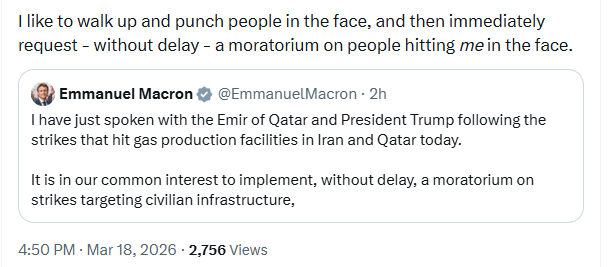
“Trump has escaped other predicaments of his own making, but there is something different about this one. The attack on Iran is so wildly inconsistent with the wishes of his own base, so diametrically opposed to their reading of the national interest, that it is likely to mark the end of Trumpism as a project. Those with claims to speak for Trumpism – Joe Rogan, Tucker Carlson, Megyn Kelly – have reacted to the invasion with incredulity. Trump may entertain himself with the presidency for the next three years (barring impeachment), but the mutual respect between him and his movement has been ruptured, and his revolution is essentially over.”
Two shipments of Russian oil and gas head to Cuba in defiance of US
If the ships arrive, they will be Cuba’s first energy shipments in three months. The island was plunged into a nationwide blackout when its entire grid collapsed on Monday before gradually regaining power on Tuesday, deepening a bitter economic crisis…Russia’s foreign ministry said on Tuesday that “Russia reaffirms its unwavering solidarity with the government and fraternal people of Cuba”.

“One of the sort of one-dimensional responses that we’ve seen is, oh, this is very bullish for solar and wind and batteries. We think quite the opposite. The fanciful pursuit of such intermittent, incomplete energy sources is part of the issue that has caused the countries that have pursued those technologies to be in the hurt locker. I think of New Zealand and Australia, for example, who are in a devastatingly bad situation, having let most of their refining capacity wither away. They’re literal islands. They have practically nothing in the form of inventory.”
Armageddon scenario’ for gas markets as Qatar hit by missiles
In normal times, a fifth of the world’s supply of liquefied natural gas (LNG) flows from Ras Laffan, a vast industrial site almost three times the size of Paris built over three decades at a cost of hundreds of billions of dollars…
“I woke up this morning and thought, ‘No, please no,’” said Anne-Sophie Corbeau, a former head of gas analysis at BP who is now at Columbia University’s Center on Global Energy Policy. “This has always been my nightmare scenario, my Armageddon scenario, the one I didn’t want to happen.”
Two gas traders said they were struggling to process the news after Iran launched a double-tap strike, firing ballistic missiles into the facility, first on Wednesday night then again in the early hours of Thursday morning. “This is unprecedented,” said one of the traders.
Gas prices in Europe rose 30 per cent as markets reopened and have more than doubled since the start of the war, as traders try to calculate the impact of months, or longer…
Before the attack, traders assumed that the flow of LNG from Ras Laffan would resume once the Middle East conflict eased and the Strait of Hormuz was safe for tankers to pass through. Gas prices, having risen last week, had stabilised far below the levels seen during Russia’s 2022 invasion of Ukraine.
But that assumption has now been shattered.
Providing an update on the damage from the missile attacks on Ras Laffan Industrial City
H.E. Minister Saad Sherida Al-Kaabi: The missile attacks reduced Qatar’s LNG export capacity by 17% and caused an estimated loss of $20 billion in annual revenue
- Extensive damage to our production facilities will take up to five years to repair and will compel us to declare long-term force majeure
This single facility produced roughly 20% of global LNG supply and, as of 2011, had taken $70 billion to build. What makes this even worse is that Iran’s strike on this was retaliation after Israel attacked their South Pars gas field which draws from the same natural gas reservoir, which is the world’s largest by far (9,700 km² - about the size of Qatar itself).
Heck, on the list of the 25 largest natural gas fields this single reservoir holds roughly 40% of their combined recoverable reserves - and is nearly 6 times bigger than the 2nd biggest field in the world. And, unlike many of the others on the list, it’s only at 10% depletion (meaning 90% of the gas is still there).
Which means that, probably for many years, a huge share of the gas from the world’s largest reservoir simply won’t be extractable, as infrastructure on both sides - Qatar’s and Iran’s - has now been blown up.
From a global energy supply perspective, we’re deep into worst-case scenario territory.
From Morgan Stanley, for what it’s worth…
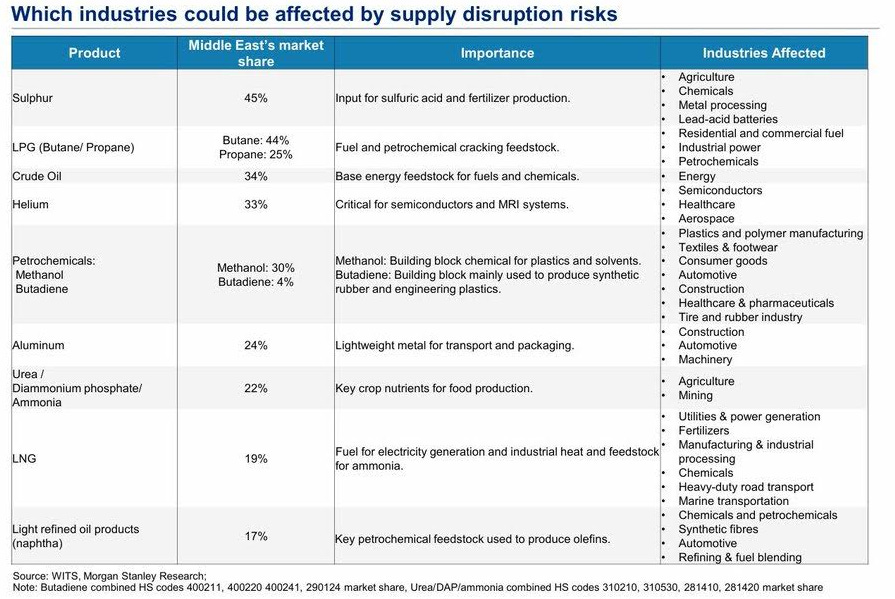
China’s crackdown on fuel and fertiliser exports spurs supply fears
China is the world’s second-largest exporter of fertiliser, after Russia, and the sixth-largest exporter of jet fuel, according to International Trade Centre data. It is trying to preserve energy and food reserves and protect the domestic market, analysts say.
“The misperception is that the Straits are closed. They’re not closed. Chinese barrels are flowing through them right now. So it’s open to Chinese and now Indian barrels. The China-block continues to be supplied. The US-block doesn’t…you’ve already done so much damage and that’s what’s not being priced…the fact that we're now at $108 and not $200 is mind-boggling.”
For a palate-cleanser, here’s a very pleasant interview with friend of the show Rupert Mitchell (The Blind Squirrel):
U.S. Regulators Propose More Lenient Capital Rules for Big Banks

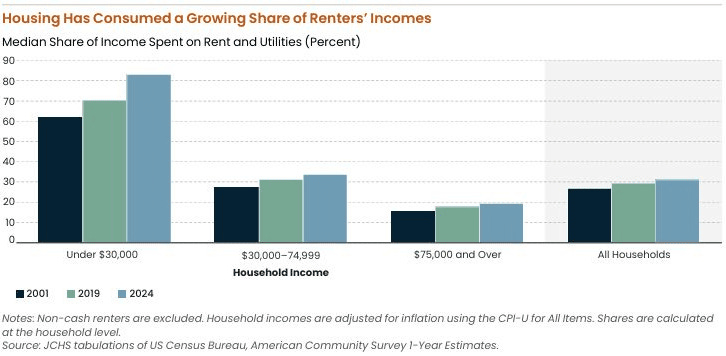
Wow.
Renters making over $75k spend about 20% of their income on rent and utilities, while those making under $30,000 spend OVER 80%!
As of 2023 (latest SSA data), 36% of wage earners made UNDER $30k.
84% made under $100K.
The pro-inflation crowd has absolutely destroyed a huge chunk of Americans.
New Home Sales Sink Nearly 20% to Lowest Level Since 2022

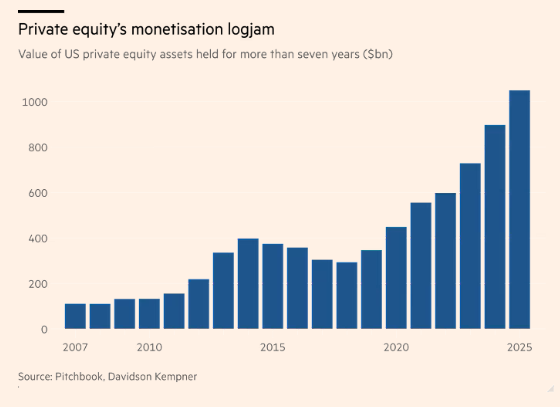
Wall St underestimates private capital problems, says top credit hedge fund
The private capital industry’s problems are far worse than Wall Street has acknowledged, as traditional metrics obscure weaknesses in the leveraged buyout market, according to a top credit hedge fund.
A “substantial portion” of the private equity industry is already “stressed or distressed”, said Tony Yoseloff, managing partner and chief investment officer at credit hedge fund Davidson Kempner Capital Management.
“You’re not looking at a problem five years from now, you’re looking at a problem that exists today.”…
Davidson Kempner is among the hedge funds positioning to make a fortune if private credit is forced to dump assets.

Private Credit’s Investor Exodus Spreads to Consumer Loans
A fund holding consumer and small-business loans made by companies including Affirm and Block is the latest corner of the private-credit market to come under stress.
Stone Ridge Asset Management told clients in the fund last week that recent redemption requests were so high that it would honor only 11% of the amount investors wanted back…
That suggests that investors’ concerns about private credit are broadening. Unlike other private-credit funds that experienced a flight of investors in recent weeks, Stone Ridge’s fund didn’t hold loans to software makers or other corporate sectors that investors fear will be displaced by advances in artificial intelligence.
Blackstone’s flagship $48bn private credit fund suffered its first monthly loss in more than three years in February, as loan markdowns and market declines weighed on returns.
The Blackstone private credit fund, known as Bcred, reported a total return of -0.4 per cent in February, its first decline since September 2022, when a broad sell-off rocked global financial markets.
Via Grant’s:
Thanks to an array of structural changes – including both the growing use of asset-backed priority debt and diminished junior debt cushions, alongside weakening covenant protection and the increasing popularity of sleight-of-hand “liability management exercises” – average first-lien recovery rates among U.S. speculative-grade corporate defaults registered at just 60% over the three years through 2025, S&P Global finds. That compares to 72% from 2018 to 2022 and 82% from 2013 to 2017. If asset-light software firms are forced to restructure en masse, that downward trend would be hard pressed to reverse.
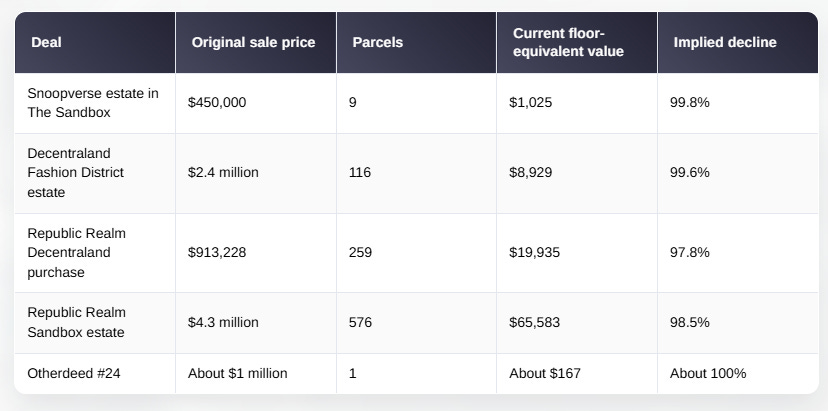
“Going by the name P-Ape, the collector just purchased a digital plot of land in Snoop Dogg’s new virtual world, Snoopverse, for $450,000 on Dec. 3, according to Decrypt.
In response to P-Ape’s purchase, Snoop tweeted, “Won’t u be my neighbor.””
In December 2021, a 3×3 Snoopverse estate next to Snoop Dogg’s property in The Sandbox sold for about $450,000, or about 71,000 SAND. That nine-parcel estate now screens at about $1,025 on a floor-equivalent basis. That is a drawdown of about 99.8% from the reported sale price.

I Predicted the 2008 Financial Crisis. What Is Coming May Be Worse.
At the start of the 2008 financial crisis, I was at a hedge fund. By its end, I was at the U.S. Treasury. At both, I worked with people only a few years out of college. The drama of 2008 was all they knew about financial markets. “Remember what’s happening,” I told them. “You’ll never see anything like this again.”
Now I’m not so sure. Maybe they’ll see worse.

“To do inflation right, you have to be a little sneaky. Especially if you don’t want your creditors feeling totally screwed and have them walk away the next time you need to borrow.
Don’t announce it as a policy. Have it just happen.
In fact, have it happen in spite of all of your best efforts to reign it in. So you need a controlled burn that looks like it is spontaneous. Who knows, maybe this idea actually is making the rounds.”
Richard Bookstaber, January 2010
“A lot of my great friends, they manage money in the bond world. And we always say the bond guys are the smartest guys in the room. It turns out it’s not true at all. They just happen to be investing in a period where interest rates are going down.”
Keith Dicker on Realvision, July 2018
April 2016
Glenn Beck: "After seeing Donald Trump on television, we thought if you wore the swim goggles and you stuck your face in crushed Cheetos, that you would look just like Donald Trump"
Some guy: "I believe it was Ben Shapiro who made this observation"
There's a metaphor for the entire Trump Administration here:
“I’ve said all along - we don’t need another tranche of documents to start prosecuting people.”
Nick Bryant
I randomly listened to this podcast years ago, and looked for it later, but couldn’t find it. I was a big fan of Phil Hartman.
This part was memorable:
I was really touched to hear Mike Myers talk about Phil Hartman’s death all these years later on “The Alec Baldwin Show”. Other than Dana Carvey, Hartman was the SNL cast member Myers had been closest to. He’d spent a lot of time with him and his wife and his kids, and he was in shock after hearing the news of his death.
When his castmates gathered for an impromptu wake, Myers kept exclaiming, “I can’t believe it. Brynn killed Phil, and then Brynn killed herself?”
Jon Lovitz, who was also in the cast at the time, said, “Oh come on, you’re making it sound worse than it was.”
Myers said they all laughed for a half hour.
“I have already intimated to you the danger of parties in the State, with particular reference to the founding of them on geographical discriminations. Let me now take a more comprehensive view, and warn you in the most solemn manner against the baneful effects of the spirit of party generally.
This spirit, unfortunately, is inseparable from our nature, having its root in the strongest passions of the human mind. It exists under different shapes in all governments, more or less stifled, controlled, or repressed; but, in those of the popular form, it is seen in its greatest rankness, and is truly their worst enemy.
The alternate domination of one faction over another, sharpened by the spirit of revenge, natural to party dissension, which in different ages and countries has perpetrated the most horrid enormities, is itself a frightful despotism. But this leads at length to a more formal and permanent despotism. The disorders and miseries which result gradually incline the minds of men to seek security and repose in the absolute power of an individual; and sooner or later the chief of some prevailing faction, more able or more fortunate than his competitors, turns this disposition to the purposes of his own elevation, on the ruins of public liberty.
Without looking forward to an extremity of this kind (which nevertheless ought not to be entirely out of sight), the common and continual mischiefs of the spirit of party are sufficient to make it the interest and duty of a wise people to discourage and restrain it.
It serves always to distract the public councils and enfeeble the public administration. It agitates the community with ill-founded jealousies and false alarms, kindles the animosity of one part against another, foments occasionally riot and insurrection. It opens the door to foreign influence and corruption, which finds a facilitated access to the government itself through the channels of party passions. Thus the policy and the will of one country are subjected to the policy and will of another.
There is an opinion that parties in free countries are useful checks upon the administration of the government and serve to keep alive the spirit of liberty. This within certain limits is probably true; and in governments of a monarchical cast, patriotism may look with indulgence, if not with favor, upon the spirit of party. But in those of the popular character, in governments purely elective, it is a spirit not to be encouraged. From their natural tendency, it is certain there will always be enough of that spirit for every salutary purpose. And there being constant danger of excess, the effort ought to be by force of public opinion, to mitigate and assuage it. A fire not to be quenched, it demands a uniform vigilance to prevent its bursting into a flame, lest, instead of warming, it should consume.”
I posted this in 2021: “I used to be a a big anti-Soviet, anti-commie (still am) Cold-War hawk. I know the talking points. I'm not a pacifist. As I've grown older, I think US neocons have done far more damage to America & the world than the Russians could ever hope to.”
Remember "Speak softly but carry a big stick". Trump is the opposite. Loudly overstates everything, and then cannot carry through. Constant bluffing does not work at this level.
Both parties have been bleeding us to death financially (and morally) for some time, and Harris promised more of he same making the last election another Hobson's Choice. I could not envision Trump going this far off the rails, and Israel's strike on natural gas fields is a blow to the whole world. No place to hide from this one
To get out of this mess we will need to pass budgets that have a surplus. Americans have shown absolutely no interest in decreasing government goodies nor increasing their taxes to generate the surplus. We are going to hit the iceberg at some point.