
Nothing is priced in.
What's Plan B?

Hello, amigos. There is a lot packed in this one. I probably could’ve organized it better by topic, but the way I do this is to add things as they pop out at me over a week or two. Things move so fast that some stuff may be dated by the time I click [send], but I try to keep it relevant. My backlog of things I may never get to is as long as ever.
As you may know, I absolutely HATE this war/military action/kerfuffle. It’s beyond belief that we are making the same mistakes again and again, often following the advice of the same people (and foreign leaders) who got us into prior catastrophes like Iraq.
After having joked about TDS for 9 years I now find myself at a Keith Olbermann-level loathing of Trump and his obsequious acolytes. Truly an amoral man. If you disagree, that’s fine with me. I’m used to people disagreeing with me.
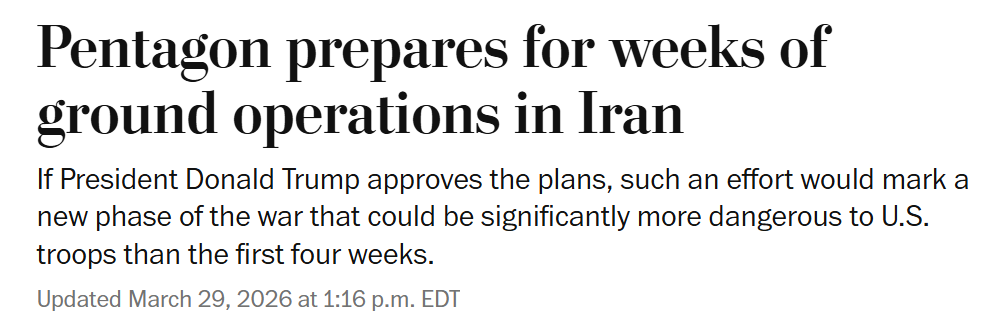
The fact that Trump is now - after many, many years of bitterly criticizing stupid mid-east wars - cheerleading (while at the same time downplaying) our latest foray into the abyss makes me think that something significantly changed. What gun is being held to his head, your guess is as good as mine.
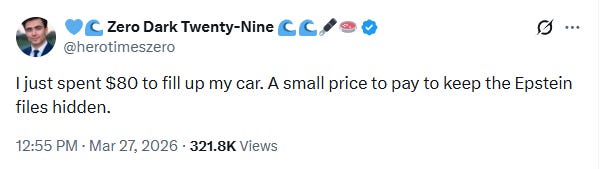
Listening to the radio today - about people waiting 4 or 5 hours in line at TSA checkpoints - it’s enraging to think that we somehow always have unlimited money and blood available in the interests of foreign wars, and bombing children in countries the vast majority of Americans couldn’t find on a map.
Much of this post is again Iran-related. Sorry. I think almost everyone is far too complacent (and mainstream media is not covering a lot of bad things that are going on). As usual, I hope to be wrong, and remain skeptically cheerful!
Most of the music in these posts is random, but not this one….
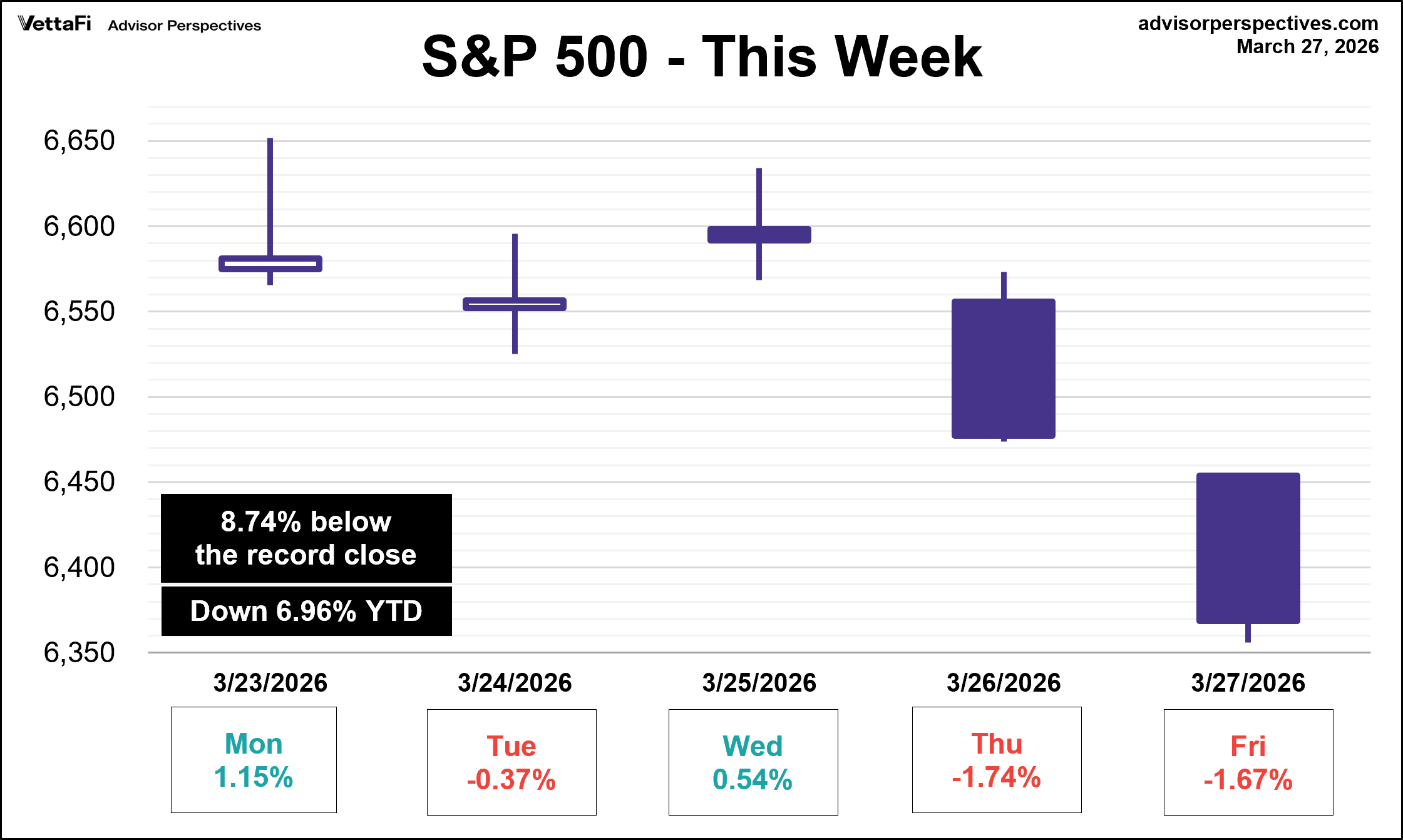
But first off, the most important thing on Earth - the stock market:
“We see people 70-years old, 80-years old that have 80% or 90% in stocks.”

“It is not the business of other nations to make American foreign policy.”
Israeli police prevented Catholic leaders from entering the Church of the Holy Sepulchre to celebrate a private Mass on the Christian holiday of Palm Sunday for the first time in centuries…

I don’t know where in the U.S. Constitution it says that a country 6,000 miles away, with a population of 10 million, must always be our #1 priority, above 340 million Americans. I missed that part.
March 11, 2026:
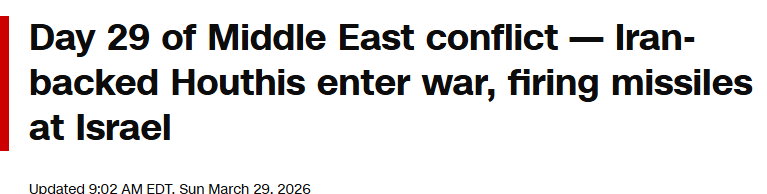
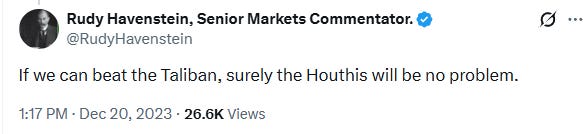
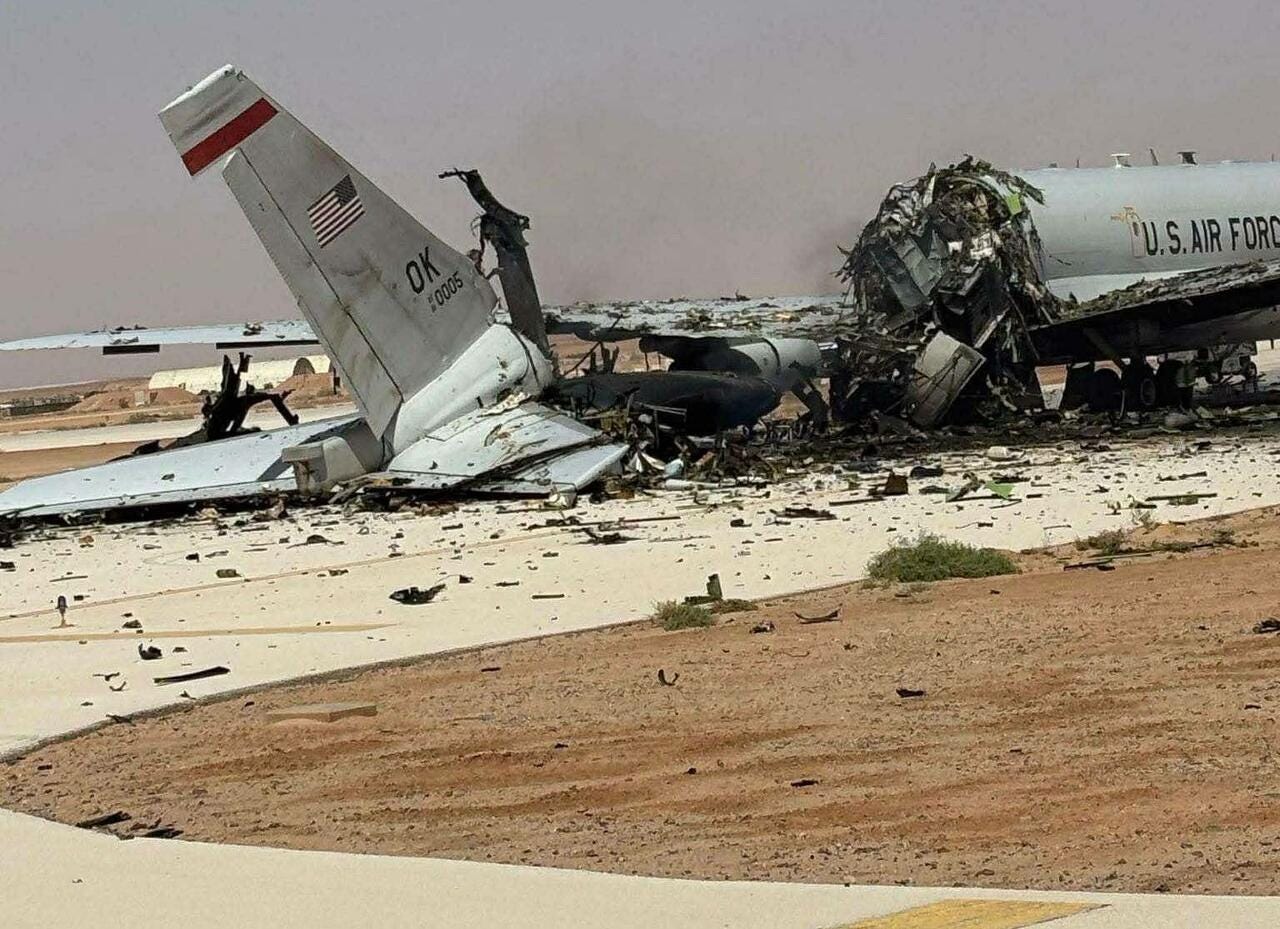
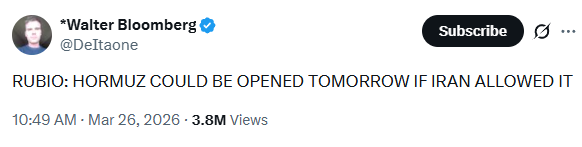
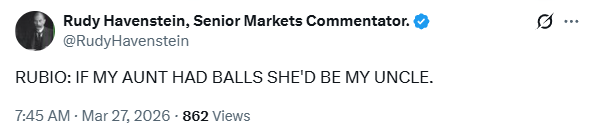
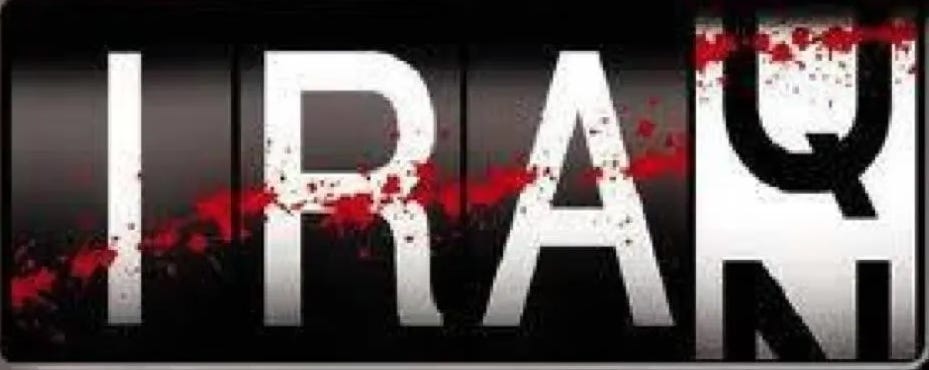
This image is about 20 years old:
“If I just look at what's priced in, nothing is priced in.
That is what's priced in. Nothing."
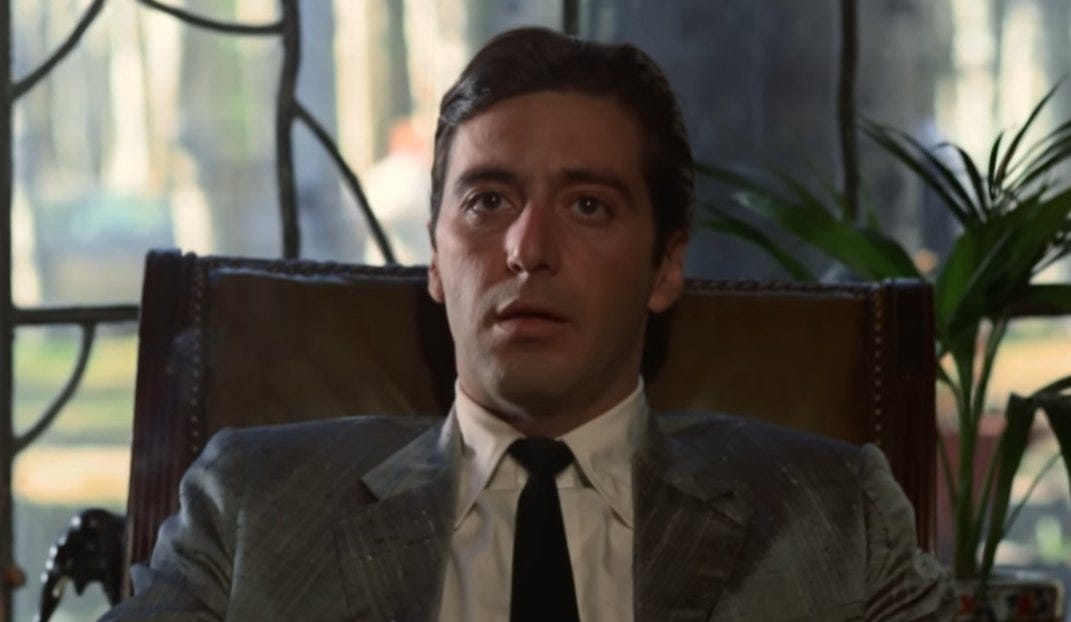
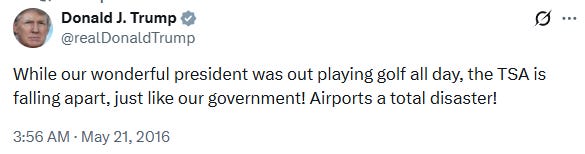
“Something has to move, which in my mind is Trump, because he’s the most movable of the three participants in the war.”
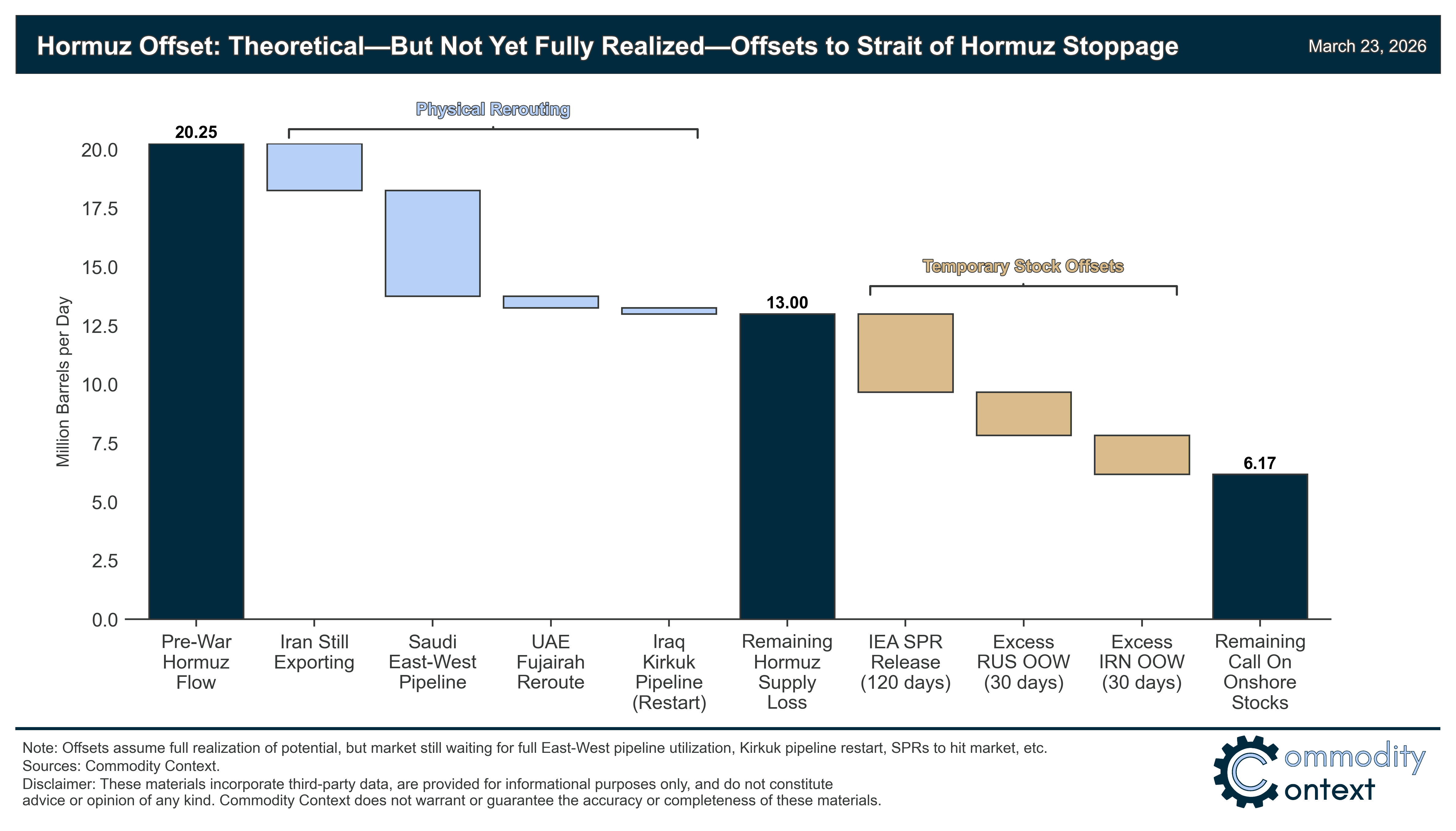
Market balance impacts from the Hormuz Stoppage are two-fold: production losses (i.e., confirmed shut-ins) and supply losses (i.e., the “air pocket” in normal exports that will hit importing nations). Confirmed production shut-ins alone are expected to push the oil market into its largest deficit on record through the end of March, and the full brunt of supply (i.e., Gulf export) losses will roughly double the immediate market impact of those realized production losses if Hormuz flow remains shut.
Are We Approaching an Unprecedented Energy Crisis?
The world’s hydrocarbon aorta has now been clogged for nearly a month. The functional closure of the strait has prompted what is quickly spiraling into the world’s most severe energy supply crisis in history, with the potential to overtake the infamous oil crises of the 1970s. Even if the war ended today and traffic resumed at full tilt, the global oil market would face months of unknotting supply chains and reversing massive depletions of inventory on hand. In other words, we’ve already unwound the past year of accumulated oil market oversupply in just a matter of weeks.
Let me be clear: If the Strait of Hormuz remains closed, there is no doubt that the global price of crude oil will explode to all-time highs. For context, I am not typically an alarmist about high-price forecasts. My first contribution to Dispatch Energy explored how the oil market was increasingly oversupplied, pushing prices lower. I was what many more price-optimistic oil market investors derisively referred to as a “glutter.” But the tables have very much turned. The continuation of the Iran war—and its possible escalation, through further attacks on oil facilities or boots on the ground—will, no doubt, force oil prices higher to (and potentially past) the peak of $147 per barrel in 2008 (about $223 in today’s money).
Matt Reed: Why There is No Off-Ramp for Trump’s Gulf War From Johnston’s Oil Ground Up podcast.
Where Will The Fertilizer Come From? Josh Linville of StoneX Group
The longer Trump’s war drags on, the worse the coming global food crisis
Iran’s Force Multiplier: Tracking the War’s Maritime and Energy Effects
Data from Kpler shows that between March 5 (as risks to shipping began to increase) and March 20, at least twenty-eight oil tankers linked to Iran transited Hormuz in both directions (empty and laden), at least eight of them in the past week…
Among them is the Nora (IMO identification number 9237539), which is believed to have loaded around 2 million barrels at Kharg Island on March 7, keeping its Automatic Identification System switched off like oil tankers often do when loading in Iran. The Nora then transited the strait on March 15 with its AIS on and was observed sailing very close to the Iranian coastline until it reached Chabahar before sailing out into the Arabian Sea.
It is unclear whether the ship’s unusual navigational behavior was related to concerns about being targeted or seized. Some reports suggest that Iran has mined certain parts of the strait, but there is no concrete evidence of this so far, and U.S. defense officials have denied it. In any case, data from MarineTraffic shows the Nora signaling China as its destination, indicating that Tehran’s oil sales to its top customer have not been disrupted by the war.
In addition, at least eight oil tankers not linked to Iran (six laden, two empty) passed through the strait between March 5 and March 20. These include the Pakistani-flagged Karachi (IMO 9903413), which crossed on March 15 with crude loaded at Das Island, United Arab Emirates, and bound for Pakistan.
Notably, the Karachi and a few other vessels have been observed sailing around Iran’s Larak Island before exiting the strait—an unusual path for a commercial vessel leaving the Persian Gulf. It remains unclear why Iran may be mandating this route. Meanwhile, Iranian authorities have reportedly demanded transit fees from some ships. What is certain is Tehran’s effort to emphasize that it is the one deciding when and how traffic resumes via the strait.
Elsewhere, data from Kpler indicates that LNG tankers have been nonexistent in the strait since February 28, including from major exporter Qatar.
“Oil is the bloodstream of the global economy, and we just instantaneously lost 20% of it. Never happened before. We’ve never lost that much, and we’ve certainly never lost it that quickly in historical oil shocks…Anything that you ran out of during Covid, I would go out this afternoon and stock up on it….the way this attack was planned will be the most consequential blunder in human history. Military, economic, geopolitical - biggest blunder in human history. That’s a big statement, and I honestly truly hope I’m wrong, but that’s the way I see it.”
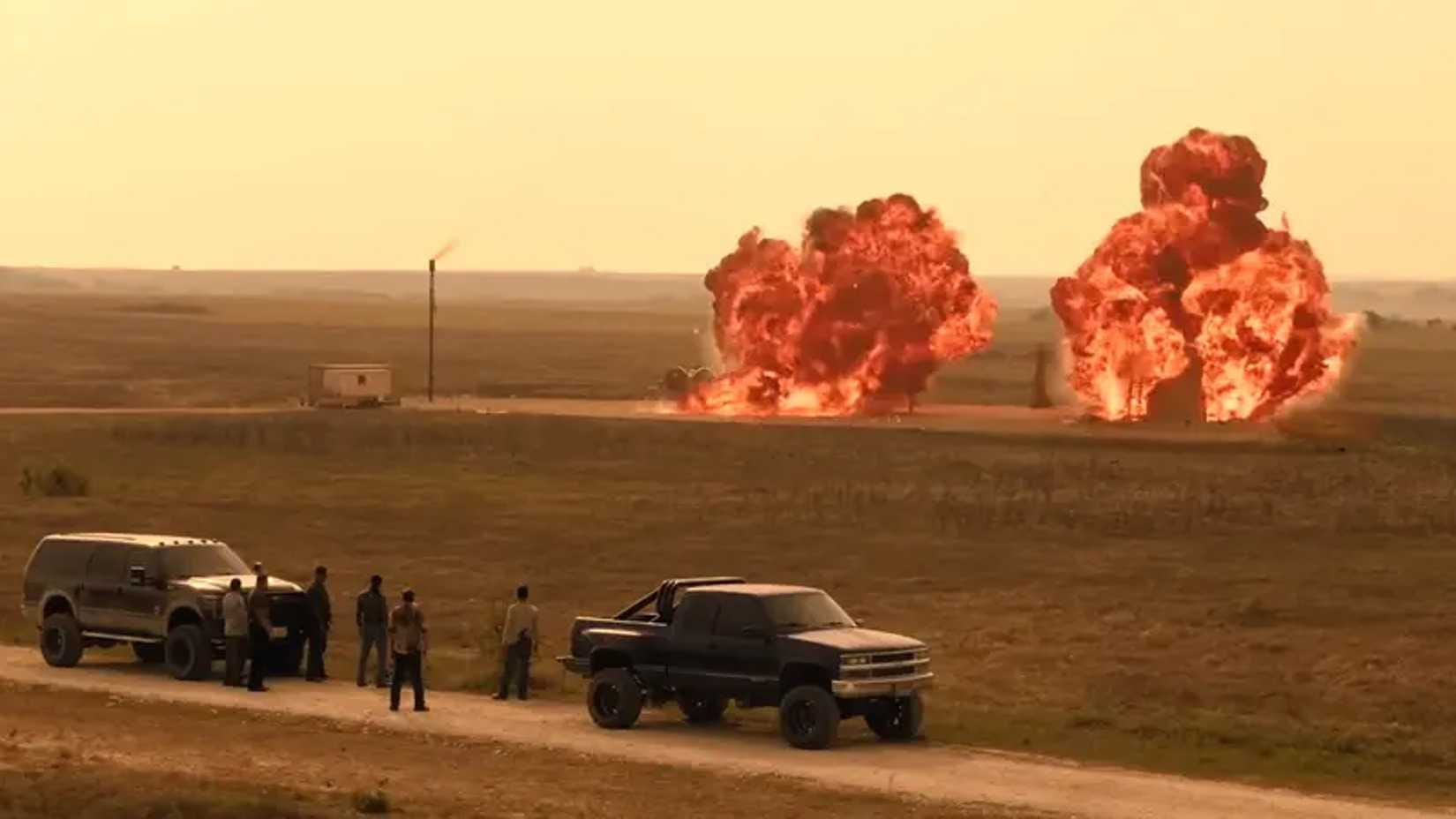
Sam Faddis
“There’s no question we have inflicted massive damage on these guys, but the idea that they were going to just surrender, roll over, or that the people were going to spontaneously rise up - it’s still a little unclear to me who exactly sold that assessment.”
“Nobody in Iran…thought, “Oh my god, we never believed they would do this.” All the guys in the leadership and in the military had said a long time ago, this is how the Americans wage war, this is how they will hit us. And then thought out precisely in advance what they were going to do next, and how they were going to respond. They didn’t all of a sudden break down in tears and say, “We have no idea what to do.” They just immediately, in a very organized efficient fashion, began to to react. So they they knew, which doesn’t mean you’re not hurting them. It doesn’t mean that you can’t win the war. It just means you have to have an accurate appraisal of who you’re fighting, and who and what you’re talking about. The guys are no joke. So you better have your act together when you go to war with them.”
“Keep in mind that the guys who run this regime in Iran have a very apocalyptic worldview. They believe that this is the end times. And essentially their version of Armageddon is coming. And on the other side of Armageddon, they win. And they actually believe that it’s their job to bring on the apocalypse…we’re back to the initial question, which is why would you think that a bunch of guys like that would quit and fold and surrender just cuz you hit him really hard, right?”
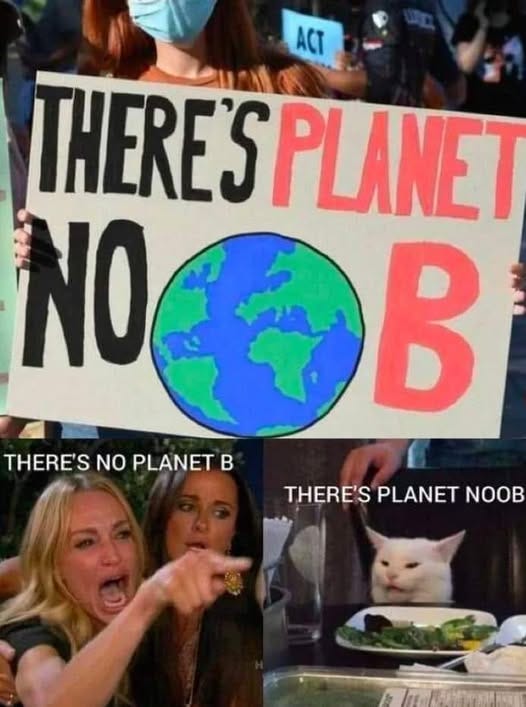
“We launched this war based on the idea that we were going to hit them really hard, really fast, with a particular focus on decapitating the regime, and then the regime was going to collapse in relatively short order. One way or the other, either they were going to quit, unilaterally surrender, there would be a coup, the people would rise up, whatever. However we got there, the Ayatollahs are gone, the theocracy is gone, and you know, it’s springtime in Iran. Not to sound too sarcastic, but I never believed that. I don’t think that was ever in the cards. It has obviously not happened. And so now the question is what’s plan B, right?”
“One of the recurring themes under the Biden administration was we’re just dropping bombs and just figuring it out later, and I feel like here we are again, just drop bombs, and there was no plan B.”
“If you want to invade Iran, in the sense that you want to invade Iran and take Iran, depose the government, and transform it, you’re going to need the U.S. Army. And you’re going to need a bigger army. What I mean by that is you’re going to need the whole U.S. Army. You’re going to have to reactivate divisions that we have shut down in recent years. I don’t know how you’re going to do that without drafting people. I mean, you’re talking hundreds and hundreds of thousands of guys on the ground.”
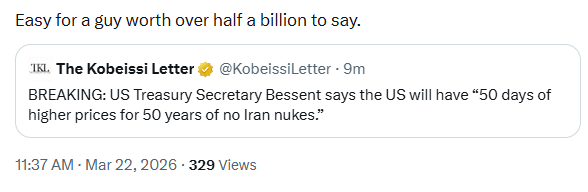
"Look at the situation from Iran's point of view. You've been in negotiations with the United States twice now with this administration, and they've attacked you twice during the negotiations. Why would you sit down in negotiations now?"

A now-deleted Telegraph article from March 23.
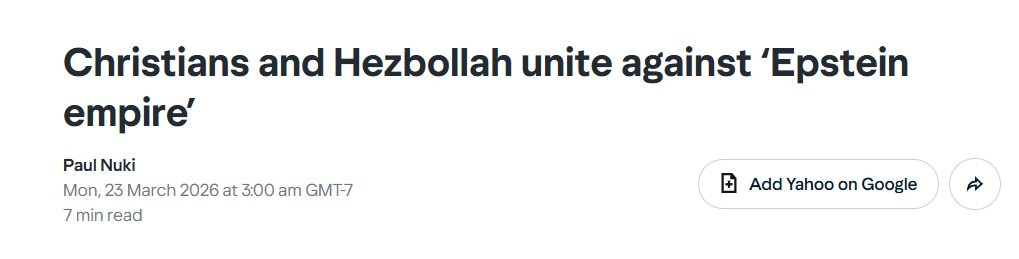
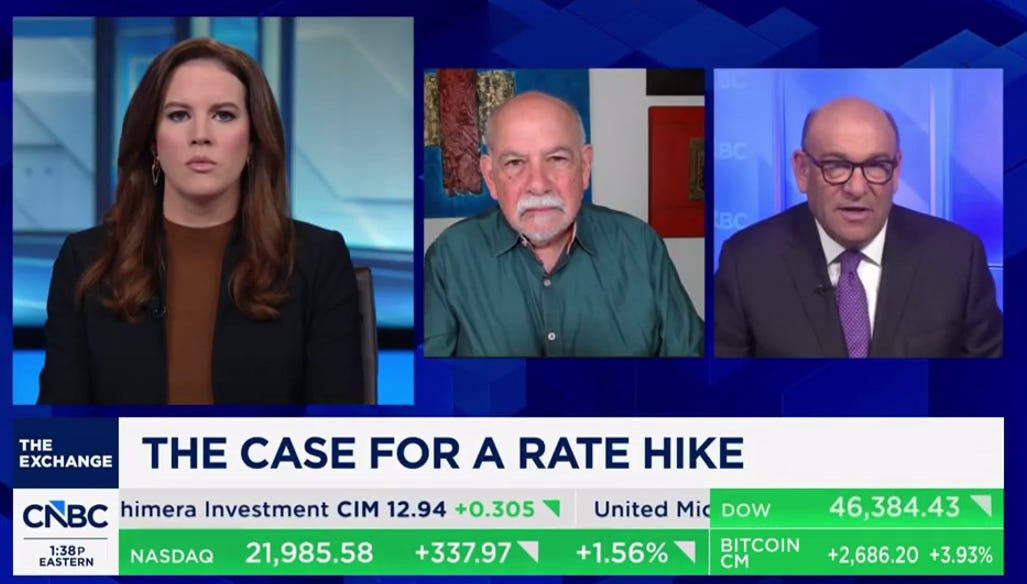
"If bad things stop happening, good things will start happening."
Dan Greenhaus on CNBC, March 27, 2026
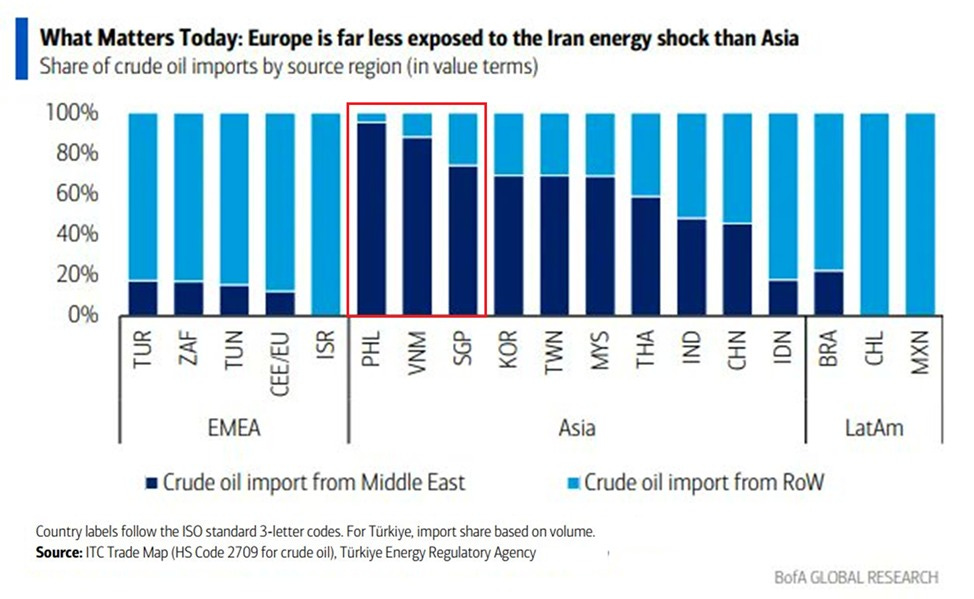
“The Philippines and Vietnam source ~95% and ~90% of their crude oil imports from the Middle East.
This is followed by Singapore, South Korea, Taiwan, Malaysia, and Thailand, each importing ~70% from the region.
India and China, the two largest oil buyers in Asia, rely on the Middle East for ~55% and ~50% of their crude imports, respectively.”
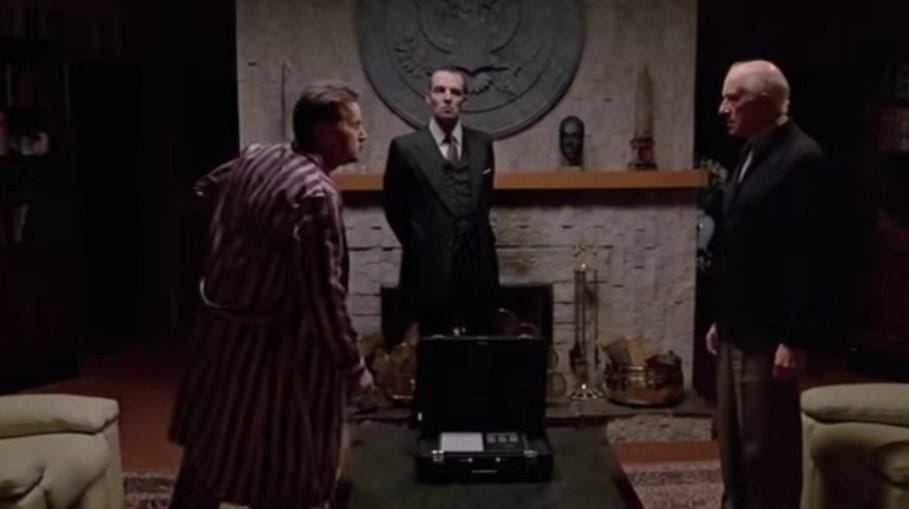
Meanwhile, in the Oval Office…
Solid advice from Tony Deden:
(Letter to shareholders of Edelweiss Holdings)
It is easy and almost unavoidable to become caught up in the headlines of the day. We witness a raging war in the Middle East, having the potential to reshape energy flows, trade routes, and even more ominously, geopolitical alignments. It seems that it could even get much worse. The headlines command our attention, financial markets respond in real time, and narratives shift by the hour. It is natural to see each development demanding immediate interpretation. Yet, we are not served well by constant reaction. Instead, we need the kind of clarity that begins by stepping back from the noise and focusing on what actually matters over time.
Governments and politicians lie. The press lies. Treating official narratives as solid ground, especially in war, is a mistake. In wartime, truth is obscured by design. Information is delayed, manipulated, framed for effect, stripped of context, and turned into propaganda. Each side presents its own story. Reporters recycle claims they cannot verify and analysts mistake access for insight. The videos that circulate on social media are often AI-manufactured. As a consequence, we are left trying to build certainty out of fragments, contradictions, and deliberate distortions. There is no denying of this reality.
In such an environment, one can spend endless energy sorting claims, disputing events, parsing official statements, and chasing “breaking news,” only to discover days or weeks later that the underlying picture was very different. In my view, the more important discipline is not reaction but inference. If truth in the moment is obscured, consequences are not. They unfold with a logic of their own. Ergo, the essential task is to think forward.
Hate Speech!
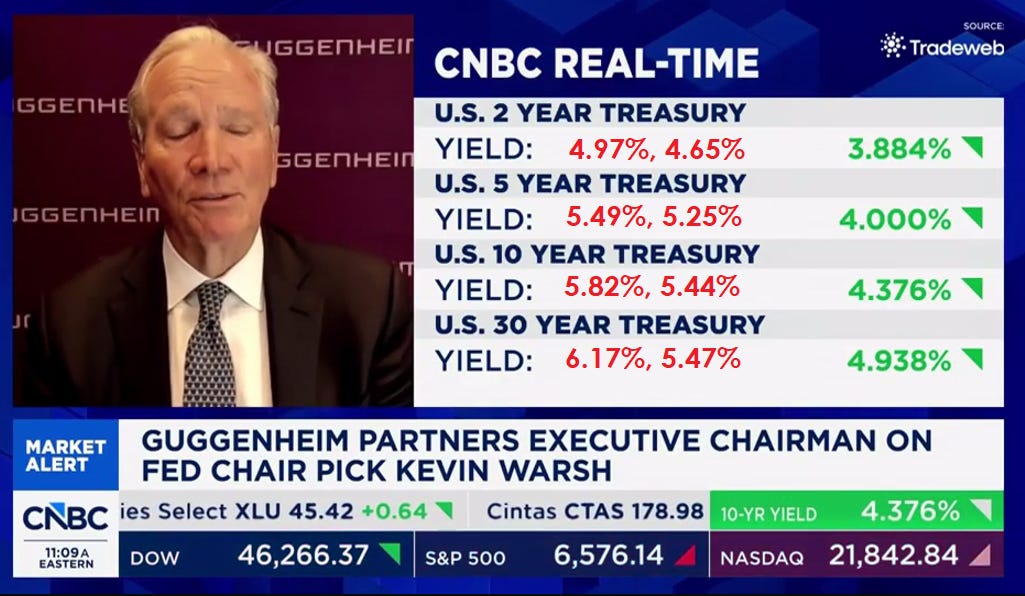
As Tom McClellan and other smart people have noticed, the Fed Funds rate usually follows the 2-year yield.
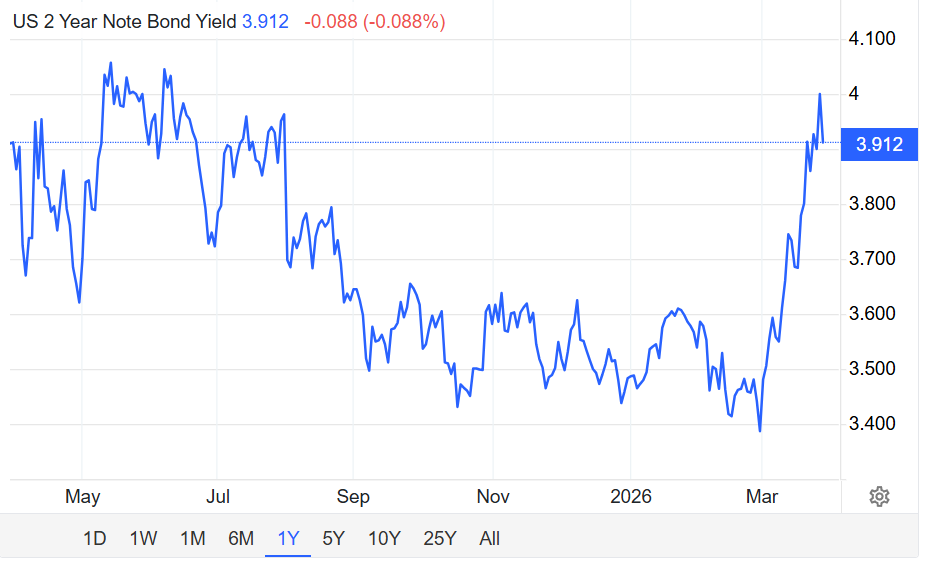
“...the FOMC ought to outsource the task of setting the Fed Funds target rate, giving that job to the 2-year T-Note yield. It does a better job of describing where the Fed Funds target should be than the humans do.”
The Fed Funds rate, at 3.5% – 3.75%, is currently lower than the two-year yield, which usually leads the way. Of course, the Fed has also been monetizing 2-year notes, so blatant (as opposed to subtle) yield-curve control may be near.
Meanwhile…
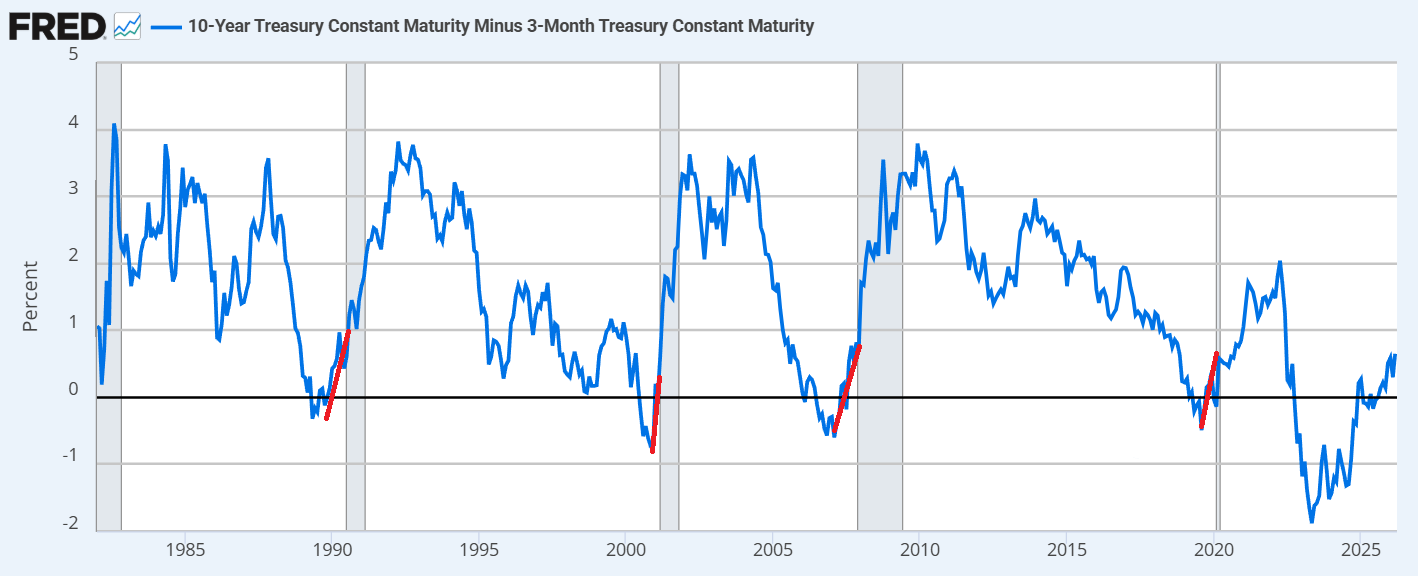
Shaded Areas Indicate Recessions
"Fannie Mae and Freddie Mac ramp up MBS buying"
Fannie Mae and Freddie Mac's retained portfolios have climbed from $158B in late 2022 to $278B as of January 2026.
We need lower home prices, not more government market manipulation.
Rates
Average and Median weekly yields on U.S. Treasury Securities at various maturities, in red, since 1976 (2-year), 1962 (5-year and 10-year), and 1977 (30-year), using FRED numbers.
Good interview on the situation for farmers
Jack Farley: “Basically just a horrible time for farmers right now?”
StoneX Vice President Josh Linville: “About the worst I can tell you I've ever seen...”
“It’s not the first-world countries that starve, right? It’s the people who are not as well off. I mean, you and I, we live with first-world problems. We don’t know what true struggle is. We don’t know what true worry is. There’s a lot of the world that is not as fortunate as we are. That’s where I start to see we could have some of the issues popping up. Again, it’s going to take some things coming together, but I’m not going to sit there and say that’s going to happen, but we are closer to repeating that happening again.”
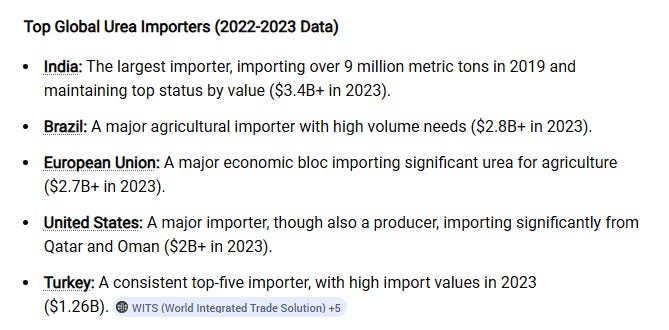
From the A.I., for what it’s worth, top Urea Importers & Exporters:
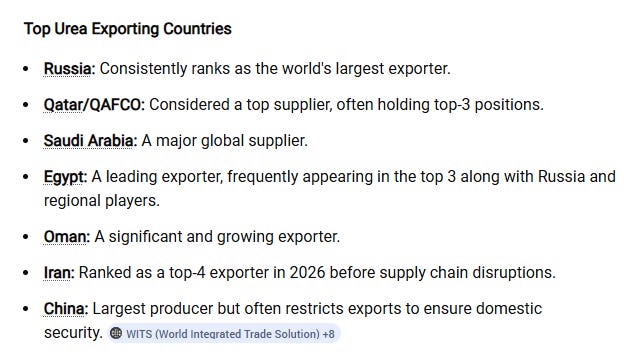
Farley: “It sounds like your outlook is so pessimistic. It’s not even dramatized at all. It’s just what it is. It’s just going to be a very, very nasty situation.”
Meanwhile, in shipping:
“I don’t know if anybody sat there and said, “Mr. President, you bomb Iran, gas prices in the US are going to go up a dollar a gallon.” - Why is that? How could that be? We’re energy independent. We create more oil than we ever need. - I don’t think anybody explained that. And I could have told you it was going to happen.”
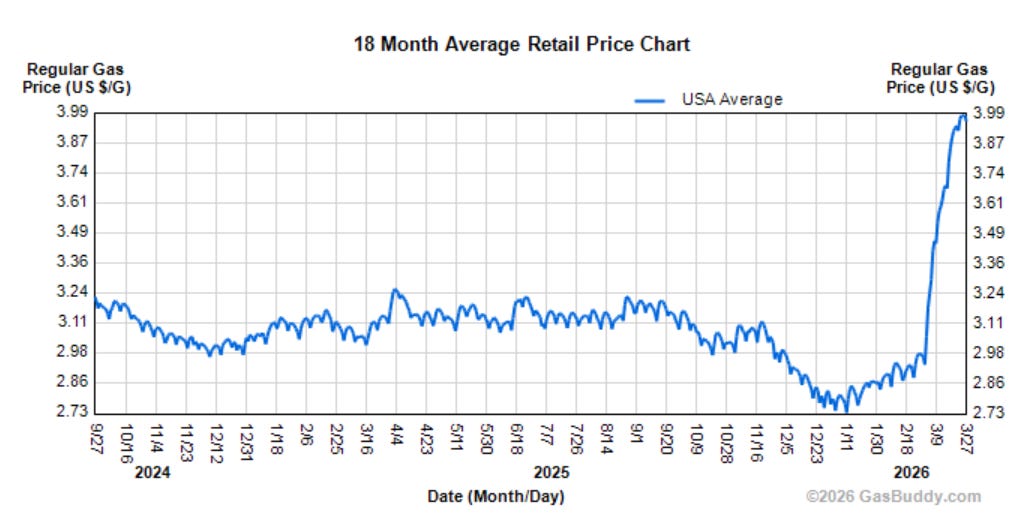
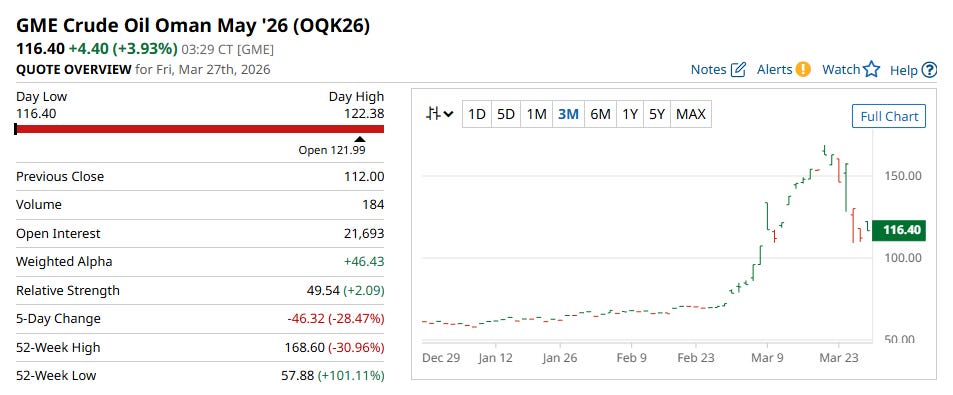
Oil/Gold Ratio
Hasn’t really moved much. Just something interesting.
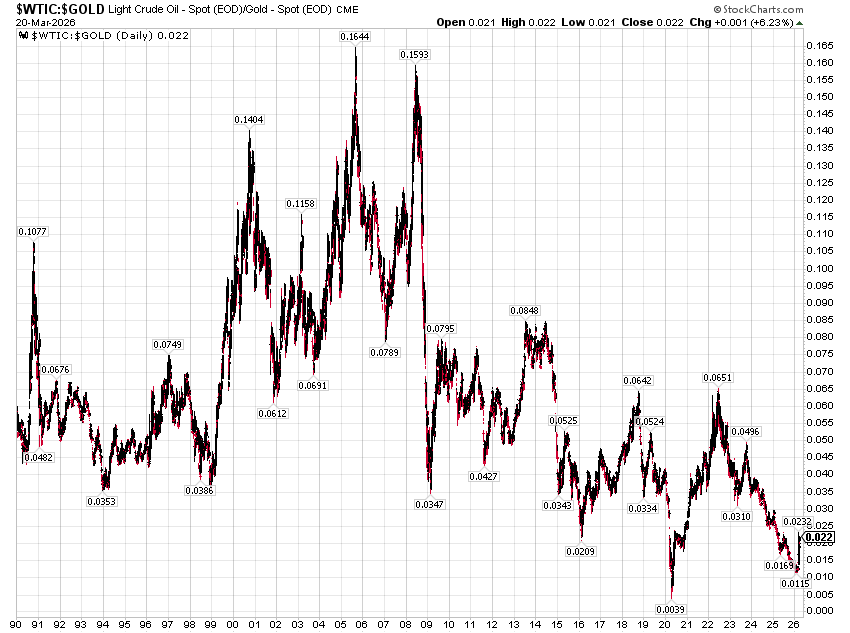
Oman Oil
From the Google, for what it’s worth:
Key Significance of the Oman Oil Index:
Primary Asian Benchmark: It acts as the key benchmark for Middle Eastern crude destined for the “East of Suez” market, allowing for accurate price discovery compared to traditional, less transparent bilateral contracts.
Unique Sour Crude Focus: Unlike Western benchmarks like WTI and Brent, which are light and sweet, Oman crude is medium-sour, making it the most reliable pricing reference for refineries designed to handle this specific quality.
Market Transparency & Hedging: The Dubai Mercantile Exchange (DME) provides a well-regulated platform for trading and hedging, essential for reducing risk against price volatility for producers and end-users.
Integral to Chinese Fuel Pricing: The Chinese National Development and Reform Commission utilizes the DME Oman contract as part of its retail fuel pricing basket, making it a critical tool for tracking Chinese demand and refinery economics.
Regional Pricing Power: As a major part of the Dubai/Oman pricing mechanism, it is used by major Persian Gulf producers to price their exports, establishing it as a “super-benchmark” along with WTI and Brent.
“People ask about munis and I typically don’t have much to say. But now, looking at the deficits caused by absurd spending, and tax policies accelerating revenue erosion, I can say avoid all General Obligation muni’s in California, Illinois & New York.”
“The dagger to the back of the consumer the dagger to consumer final demand growth here in the US would be another bout of inflation. It’s not coming. It’s here already…Inflation is high already in the pipeline before the war, and people are not, I don’t think, fully either grasping that or caring or looking.”

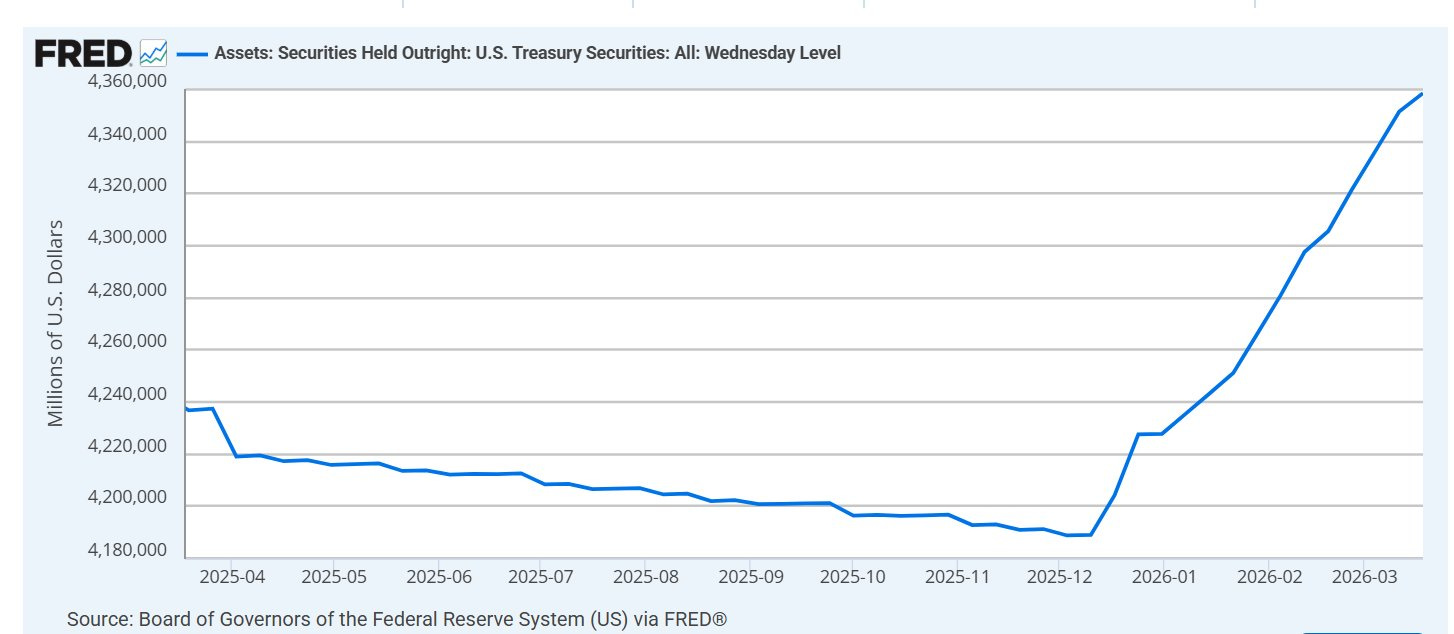
“The Fed is going to be forced to buy more and more Treasury debt…and the result will be inflation, because when the Fed buys Treasury securities, you grow the banking system. That’s what happens, and that growth translates almost immediately into asset price inflation. And that’s kind of how we got to where we are today.”

From friend of the show Marty Bent:
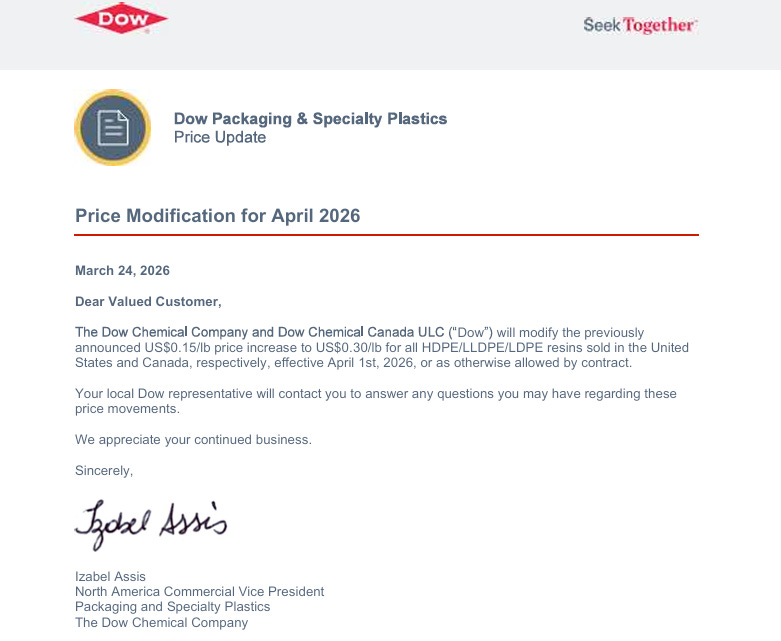
Dow Chemical just doubled their polyethylene price increase, from $0.15/lb to $0.30/lb, effective April 1st. That's roughly a 60% price hike on the most widely used plastic on Earth.
LyondellBasell has gone even further, $0.35/lb in cumulative increases through May.
Polyethylene is in your packaging, your water bottles, your grocery bags, your construction materials, your medical supplies. About 50% of global production capacity is now either offline or feedstock-constrained because of the Hormuz crisis.
This is how a war in the Middle East shows up at your grocery store. Energy costs don't stay in the energy sector. They flow through everything you buy.
A memorable passage from the book, “Dying of Money”:
Industrial stocks, the darling of the inflationary speculation, had a peculiar history. At the height of the boom, stock prices had been bid up to astronomical price-earnings ratios while dividends went out of style. Stock prices increased more than fourfold during the great boom from February 1920 to November 1921. Then, however, shortly after the first upturn of price inflation and long before the inflationary engine faltered and business began to weaken, a stock market crash occurred. This was the Black Thursday of December 1,1921. Stock prices fell by about 25% in a short time and hovered for six months while all other prices were soaring.
The real value of stocks declined steadily because their prices lagged far behind the prices of tangible goods, until for example the entire stock ownership of the great Mercedes-Benz automobile manufacturer was valued by the market at no more than 327 cars.
Investors were extremely slow to grasp that stocks were poles apart from fixed obligations like bonds, quite wrongly thinking that if bonds were worthless stocks must be too.
Nearer the end in 1923, relative prices of stocks skyrocketed again as investors returned to them for their underlying real value. Stocks in general were no very effective hedge against inflation at any given moment while inflation continued; but when it was all over, stocks of sound businesses turned out to have kept all but their peak boom values notably well. Stocks of inflation-born businesses, of course, were as worthless as bonds were.
‘Yes, AI Is a Bubble. There Is No Question.’
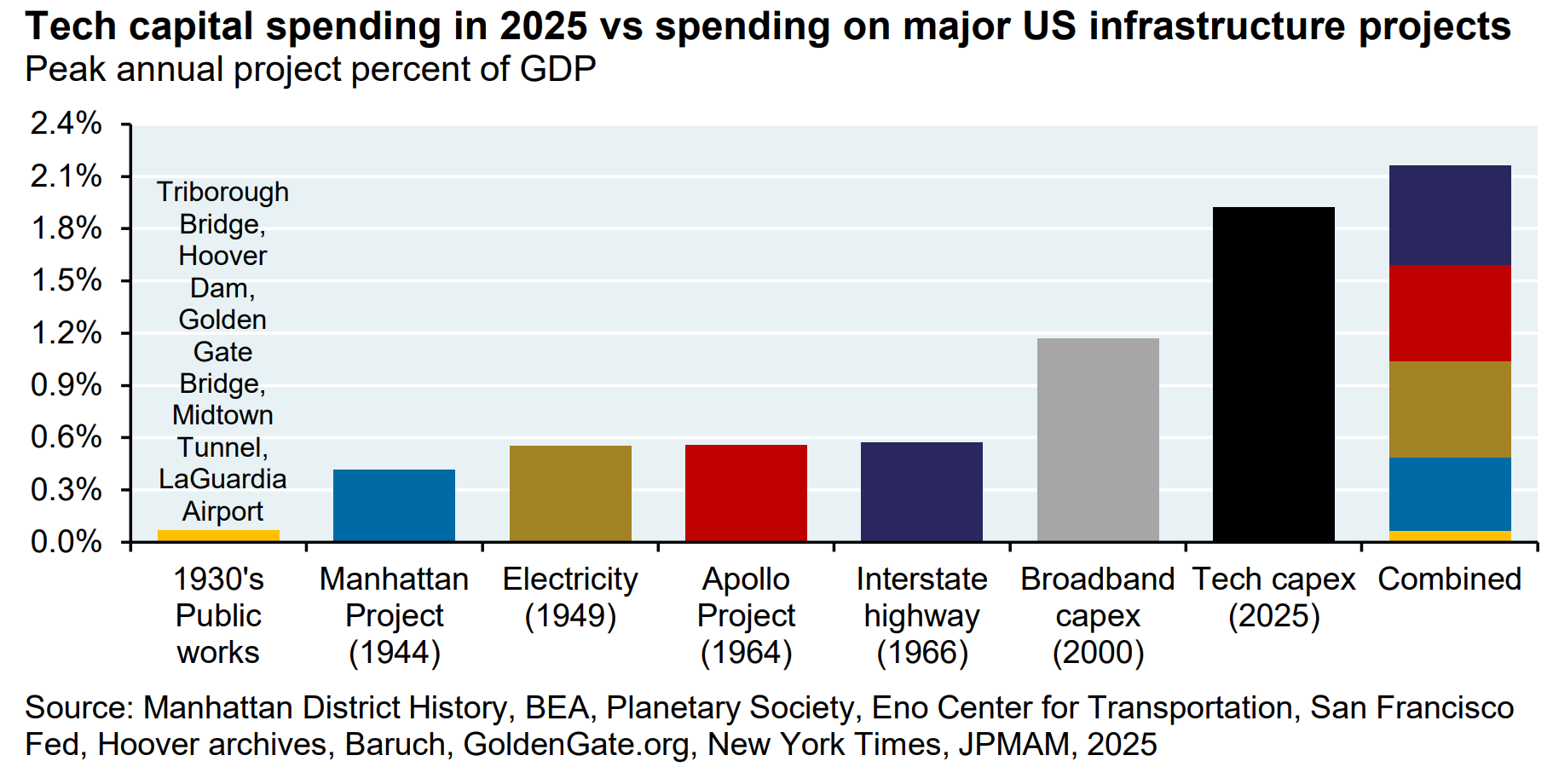
As a share of GDP, companies are currently devoting more resources to AI than the combined peak annual capital spending on key 1930s public works projects and the Manhattan Project and the 1940s electricity boom and the Apollo Project and Interstate highway construction. It’s important to note that AI spending is overwhelmingly financed by the private sector, whereas most of those infrastructure projects were financed by the largesse of the federal government. Once again, nothing like this has ever happened before, and if you feel extremely confident about how this is going to turn out, I think you might be crazy.
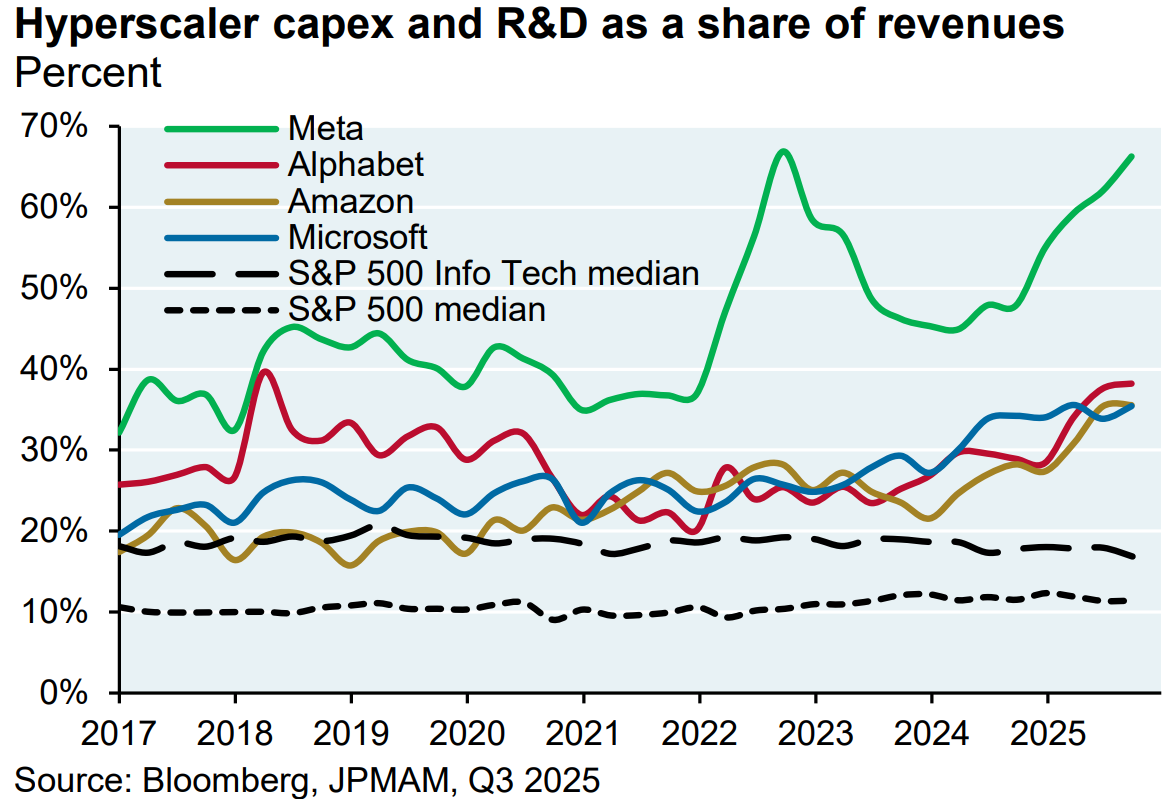
I found it amusing that Paul Kedrosky - who is mentioned in the article - blocked me on Twitter. I never interacted with him, and he hasn’t been active on Twitter in 10 years.
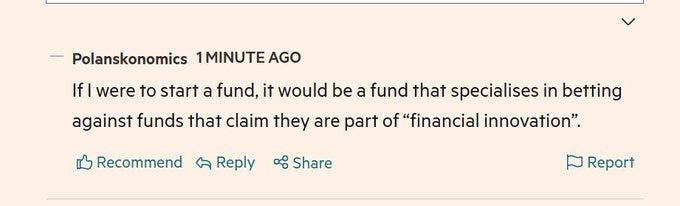
UBS gates €400mn property fund for up to 3 years
UBS said in the letter it was gating the Germany-based fund because its liquid assets were insufficient to “pay the redemption price for the shares submitted for redemption and to ensure the proper ongoing management” of the fund
Ares Private Credit Fund Posts Steepest Monthly Loss on Record
Jeff Gundlach
“The Federal Reserve is not allowed to buy corporate bonds, by its charter. But they bought corporate bonds in a small way in the aftermath of the of the lockdowns. So that was illegal. You know, back in 2006, there were prospectuses on $2 trillion of mortgage back securities that were not guaranteed that said these mortgages cannot be modified under any circumstances. In plain English, it said this in the prospectuses, yet they modified millions of mortgages in the United States. So rules can be changed, and I’m very nervous about exposure to long-term Treasury bonds.”
“The private credit situation, which is shockingly similar in size to what subprime and non-guaranteed mortgages were in 2006. People say it’s not very big. It’s only two or three trillion. Well, that’s what that market was during 2006 going into the global financial crisis. And I just think that this is going to be a very long, drawn-out story.”
“The problem obviously is everybody is increasingly aware that the private credit market - the marks are not real marks.”
“I had an insurance company client come in, very big insurance company client, and they were very involved in private credit. And they said that they had
several managers and that eight of the managers that they had owned this exact same position, the exact same one. Which is typical….hw said, “I’ve got eight managers that own exactly the same position. One of them has it priced at 95 and another one has it priced at eight.” What? Wait, what? Different mark to markets. Oh my gosh. On the same exact holding. One had it marked at 95 and one had it marked at eight. And that really opened my eyes, because I hadn’t had that kind of visibility into what was going on there. But then all of a sudden last summer or early last fall you started get these weird things where one fund bonds got marked from 100 to zero.”
“Starting in about 2023, all the way up until the present moment, the very first question that gets asked in the Q&A session is what do you think about private credit, and it got asked so many times that I started answering it by saying “I guess you’re asking because you own a lot of it, right?” and they all say “yep.”…So there is no incremental buyer. There’s only incremental sellers.”
“Harvard with a 50 odd billion dollar endowment didn’t have enough liquidity to pay a couple billion dollars of expenses, which shows you how locked up people and institutions and plans really are.”
“One thing I think anybody that’s been around the block even half as many times as I have been knows is that the withdrawal requests from private credit are going to be way higher in June than they were in March. Because when you ask for 14%, and they give you five, the next thing you do is you ask for 40.”
“I take risk very rarely, and I want a big fat pitch when I’m going to take risk, and I don’t think spreads on high0yield widening by 50 to 70 basis points from the all-time tights comes close to being a fat pitch. I think high-yield spreads were at 350, now they got out to about 425. Call me when they’re at 700.”
“Gold is real money. I think people are starting to get aware of that. Central banks are going to be a huge continued source of demand for gold.”
Ron Paul and Ben Bernanke in 2011
“The thing I would avoid the most I think would be Chicago munis.”
Prediction for 2028: “The Democrat and Republican parties have created tremendous blockages to third parties having a chance to succeed. But interest in the third party will be high enough to overcome those blockages.”
“The hardest environment was 2021, where there was no yield in the bond market. There there was a moment where the only way to get 5% from US fixed-income was to buy the junk bond index and leverage at 50%. And hope for no defaults, because the junk bond index yielded three and a half to no defaults. Believe it or not, if you had done that, if you had gone for that 5% by buying the three and a half index and leveraging it 50%, you’d have gone bankrupt, because your borrowing cost went up to five and 3/8 and your coupon is still three and a half. So you had a negative arbitrage of almost 2% that you you were bleeding, every minute of every day. and the price of your junk bonds was significantly below cost. So you were margin called.”
“The one thing that is the most dangerous is not fear or greed. It’s need. I need to make X percent.”
‘More money has been lost reaching for yield than at the point of a gun.’
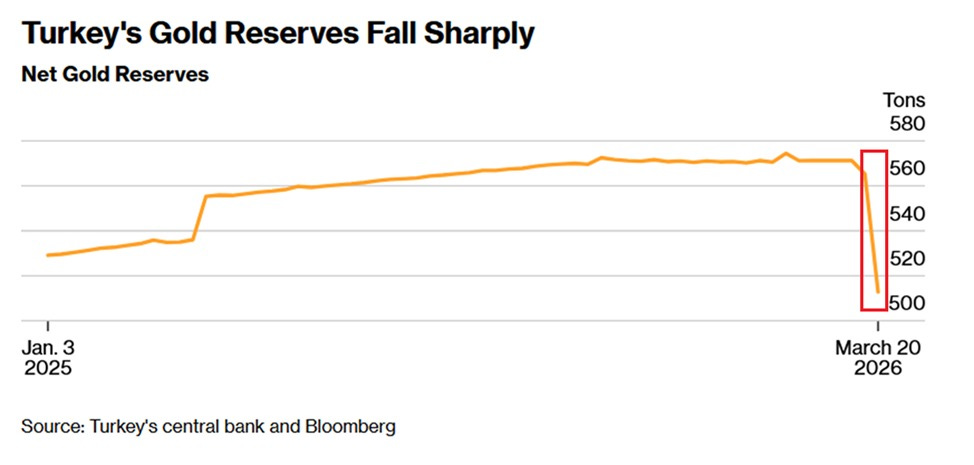
Looks like Turkey has been dumping gold…
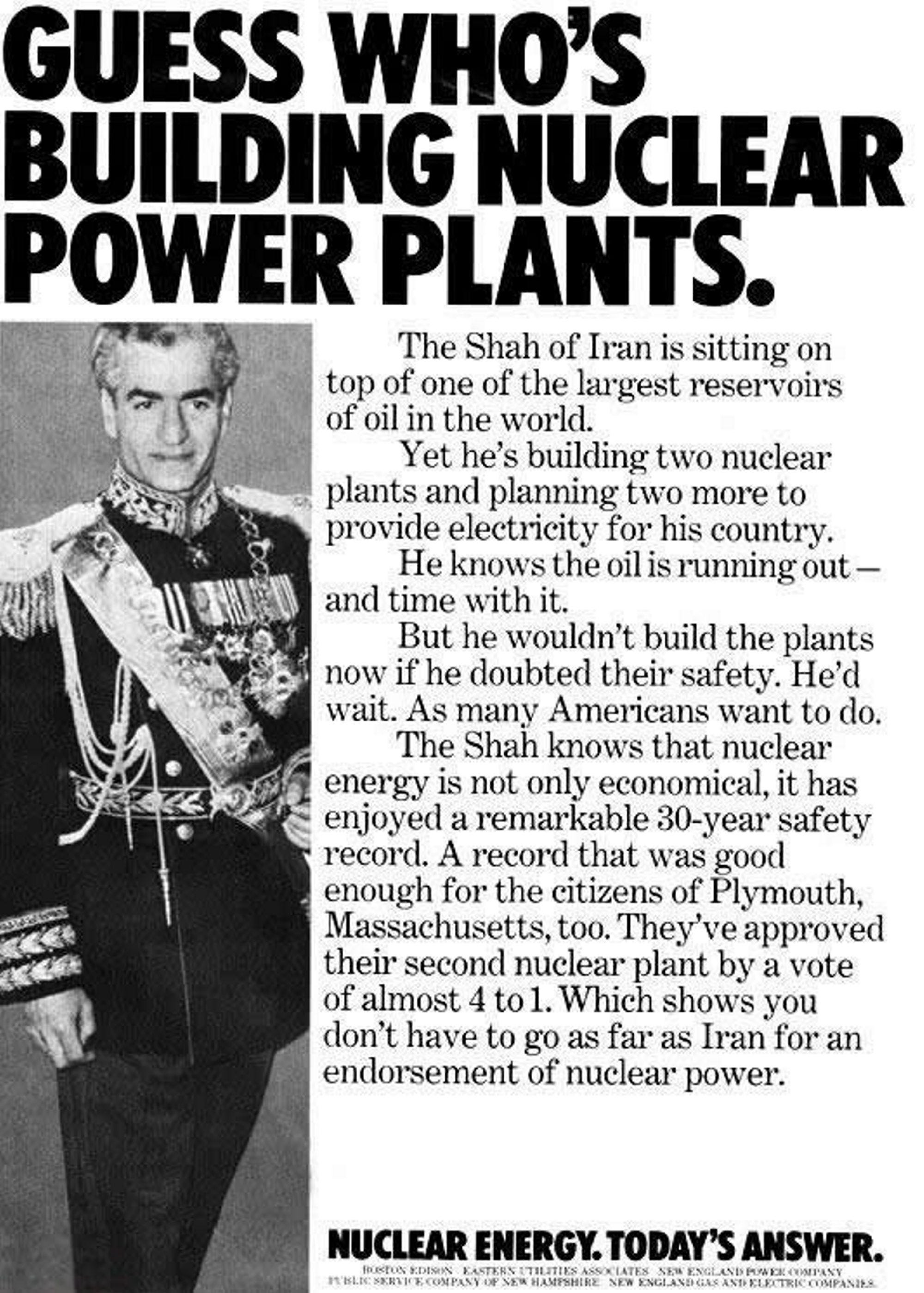
Patrick Theros, former U.S. Ambassador to Qatar
“When we talk to an American about Iranian/U.S. relations, and why are they so bad, he goes back to 1979 and the taking of the hostages in the embassy.
When you talk to an Iranian as to why Iranian/American relations are so bad, it goes back to 1953 and the coup d'état that overthrew the first democratically elected Prime Minister at the time of Iran, because he was going to nationalize the British-owned petroleum company, the Anglo Iranian Petroleum Company. So we were doing a favor to the Brits and helped overthrow the first democratically elected government of Iran.
You mention this to Americans, and I’ll tell nine out of every 10 Americans I speak to about Iran are totally unaware of what happened in 1953.”
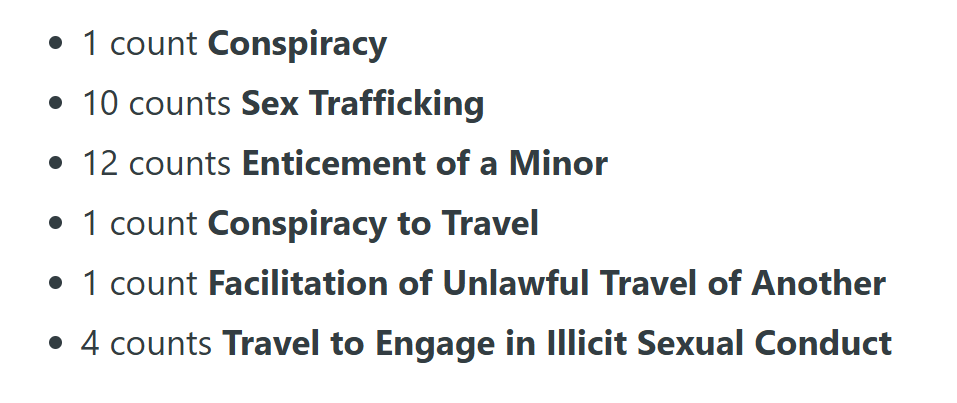
Jeff Epstein's original, pre-sweetheart deal, Florida indictment.
Followed by a governmental cover-up.
28 minor females.
225 overt acts individually described supporting an indictment that includes:
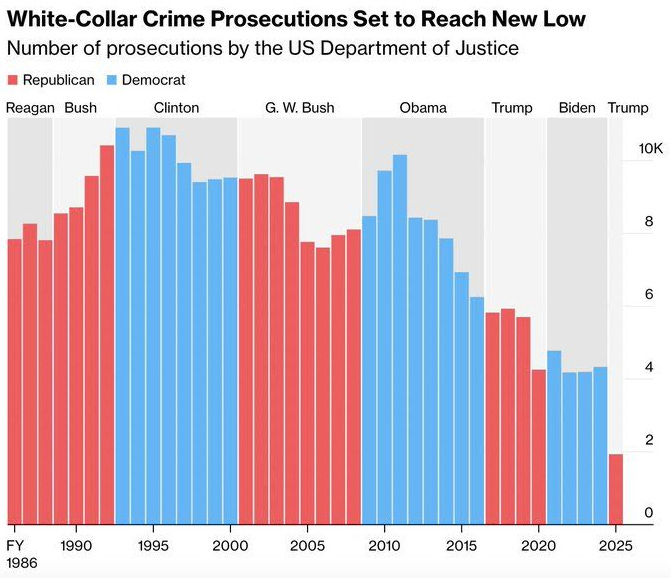
Speaking of cover-ups…
“what people mean by the rise of the Epstein class in a graphic”
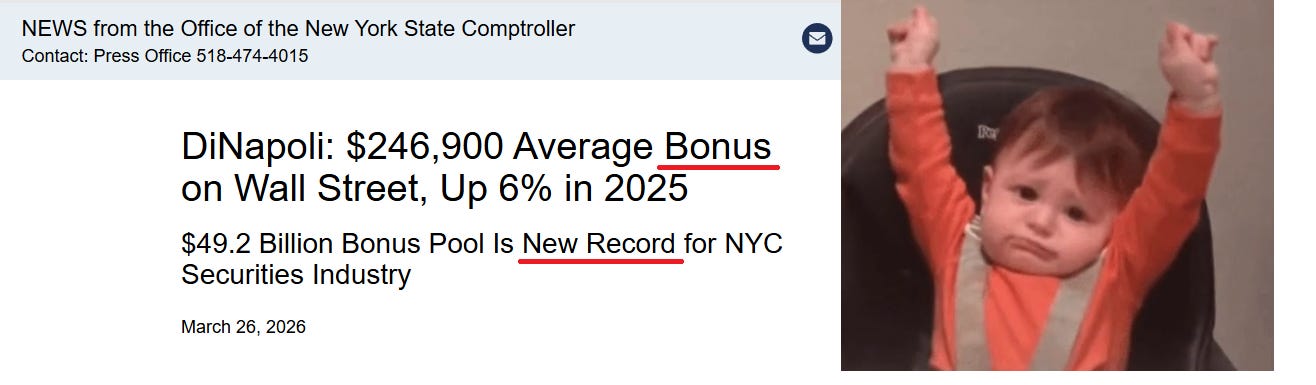
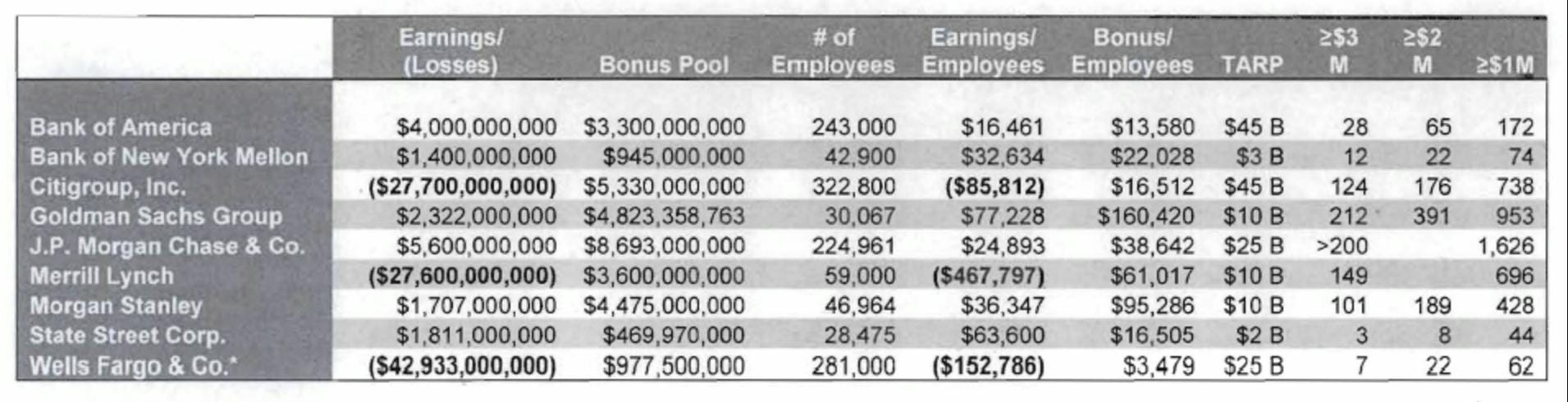
In 2023 (latest SSA data available), about 97% of wage earners made less than a typical 2025 Wall Street BONUS.
SSA Link
Car Seats As Contraception
We show that laws mandating use of child car safety seats significantly reduce birth rates, as many cars cannot fit three child seats in the back seat. Women with two children younger than their state’s age mandate have a lower annual birth probability of .73 percentage points. This effect is limited to births of third children, households with access to a car, and households with a male present, where both front seats are likely to be occupied. We estimate that these laws prevented fatalities of 57 children in car crashes in 2017 but reduced total births by 8,000 that year and have decreased the total by 145,000 since 1980.

Ted Kaczynski
From Key Cases in Forensic and Criminological Psychology by R. Stephen Walsh
At 16 years of age, Ted won a place at Harvard University, majoring in mathematics, where he began his studies in September 1958. Harvard, at the time, was an impersonal place where ‘preppies’, privately schooled students from privileged Ivy League backgrounds, rubbed along uncomfortably with ‘wonks’, lowly high school graduates. Ted had moved to a world of patricians and plebs where former high school students were particularly isolated, with most of them coming from other states, in contrast to the former prep school students who tended to have grown up nearby. Yet, Ted seemed to be doing OK. During his freshman year, his grades evidenced a balanced student who was on-track to realise his potential. The health services doctor who performed the medical exam that all freshmen underwent, reported: ‘Good impression created. Attractive, mature for age, relaxed. … Talks easily, fluently and pleasantly … likes people and gets on with them. … Exceedingly stable, well integrated and feels secure within himself. Usually very adaptable. May have many achievements and satisfactions’ (Chase, 2003, p. 184)
Thus, we have a sense of Kaczynski as a somewhat conflicted figure. At 16 years of age, Ted was an outsider who was perceived as integrated, capable and well-adjusted by the educational authorities that he encountered. He was a child of the Cold War. He was much younger than most of his classmates, he had skipped two years at school, he was a loner and a mathematician. There are many people who share some or all of these characteristics.
An unusual aspect of Ted Kaczynski’s time in Harvard was his participation in a series of experiments entitled ‘Multiform Assessments of Personality Development among Gifted College Men’, conducted by a team of psychologists under the leadership of Professor Henry A. Murray of the Department of Social Relations. In common with others who took part, Kaczynski was recruited from his Harvard class, as a sophomore, and continued to participate in Murray’s research over a period of three years. Each participant contributed about 200 hours to the research.
Henry Murray, born in New York City, was a Harvard professor of psychology, famed for his classic 1938 work, Explorations in Personality. During the Second World War, Murray had served with the Office of Strategic Services (OSS), the precursor to the Central Intelligence Agency (CIA), where he had held the rank of Lieutenant Colonel and was responsible for the selection of secret agents. Following the Second World War, the aristocratic Murray, who had both a medical degree and a PhD in biochemistry, returned to his academic career at Harvard. Here, Murray became a Cold War warrior, focused on serving America’s defence interests, paying particular attention to ‘brainwashing’. It was in this context that Murray’s path crossed with the ill-starred and very young Ted Kaczynski.
‘Brainwashing’ is the idea, originating in the Cold War, that the thoughts and beliefs of another person can be altered, against that person’s will, through the application of psychological techniques. The CIA believed that the Soviets had developed these techniques and, consequently, the Americans needed to master them too. In the context of national defence, social science, including psychology, became a vehicle whose purpose was not merely to understand humanity, but to control it too. To this end, the CIA and US establishment pumped huge amounts of money into psychological research. Professor Henry Murray and the Harvard Psychological Clinic were among the beneficiaries of this funding.
The purpose of Murray’s research was to harness standardised tests and projective measures with intensive study of social interaction, responses to stress, and memory in order to further understand personality in a manner that was useful to the armed forces. The Rockefeller Foundation funded the research, which began in 1949 and built on prior research that had commenced in 1941. Murray recruited 20 students, all men, from each of the Harvard cohorts of 1942, 1952, 1955, 1959 and 1962. One of these recruits was the 16-year-old Ted Kaczynski.
It is now apparent that the research in which Ted Kaczynski participated was deeply unethical. When the extent of Nazi medical experimentation in the Second World War became known, the Allied forces sent those Nazi doctors involved in murderous human trials, including high altitude, hypothermia and seawater experiments, for trial at the International Military Tribunal at Nuremberg. One important outcome of the ‘Doctors’ Trial’ was the publication of the Nuremberg Code, which is probably the most important document in the history of the ethics of medical research. The first article of the code states that ‘The voluntary consent of the human subject is absolutely essential’.
In the autumn of 1959, Ted Kaczynski received an invitation to take part in the research: ‘Would you be willing to contribute to the solution of certain psychological problems (parts of an ongoing program of research in the development of personality) by serving as a subject in a series of experiments or taking a number of tests (average about 2 hours a week) through the academic year (at the current College rate per hour)?’ Those who volunteered were given a battery of tests. The researchers were seeking to recruit a proportion of very well-adjusted students, a group of average students, and a group of very alienated students. Screening identified Kaczynski as the most alienated student of the cohort. It is noteworthy that Kaczynski was not enrolled on the psychology course where recruitment was advertised, and it may be that Murray was aware of Kaczynski’s isolation and alienation, and considered him a prime candidate, going out of his way to recruit Kaczynski.
The consent form used in the Murray study did not say that the study would last three years, it did not say that the students would be deceived, and it did not say anything about the possible effects of the study. The study asked participants to write an essay about their personal philosophies. Researchers then measured physiological responses while confederates used the essays as a basis to launch personal attacks and insults on participants with the specific aim of humiliating and denigrating participants. Ted Kaczynski took part in this research for more than 200 hours and there seems little doubt that participation had a deleterious impact on his mental health and emotional well-being.
Might the "gun" have been a Chinese cruise missile under discussion/negotiation well before the byline date?
"LONDON, Feb 24 (Reuters) - Iran is close to a deal with China to purchase anti‑ship cruise missiles, according to six people with knowledge of the negotiations, just as the United States deploys a vast naval force near the Iranian coast ahead of possible strikes on the Islamic Republic.
The deal for the Chinese‑made CM‑302 missiles is near completion, though no delivery date has been agreed, the people said. The supersonic missiles have a range of about 290 kilometres and are designed to evade shipborne defences by flying low and fast. Their deployment would significantly enhance Iran’s strike capabilities and pose a threat to U.S. naval forces in the region, two weapons experts said."
Obama forgot about ballistic missiles in the 18-page JCPOA.
This was such an enjoyable read. Thank you.