Jim Grant: ‘Nixon Shock’ Was Really a Coup de Grace on Destruction Others Started
“The promise that Nixon took to the airways to break proved to be, in fact, the final check on the inflationary impulses of the modern age. The Kennedy and Johnson administrations had obliterated the sidelines and the base lines on the monetary tennis court. It fell to Nixon to take down the net and fire the umpires.
His successors, Democrat and Republican alike, would demonstrate the possibilities for money-printing, interest-rate suppression, public spending, and international payments imbalances in the absence of fixed exchange rates and a convertible dollar.
Nixon merely finished the monetary destruction work that others had started. In that sense, August15, 1971, was the coup de grace.”
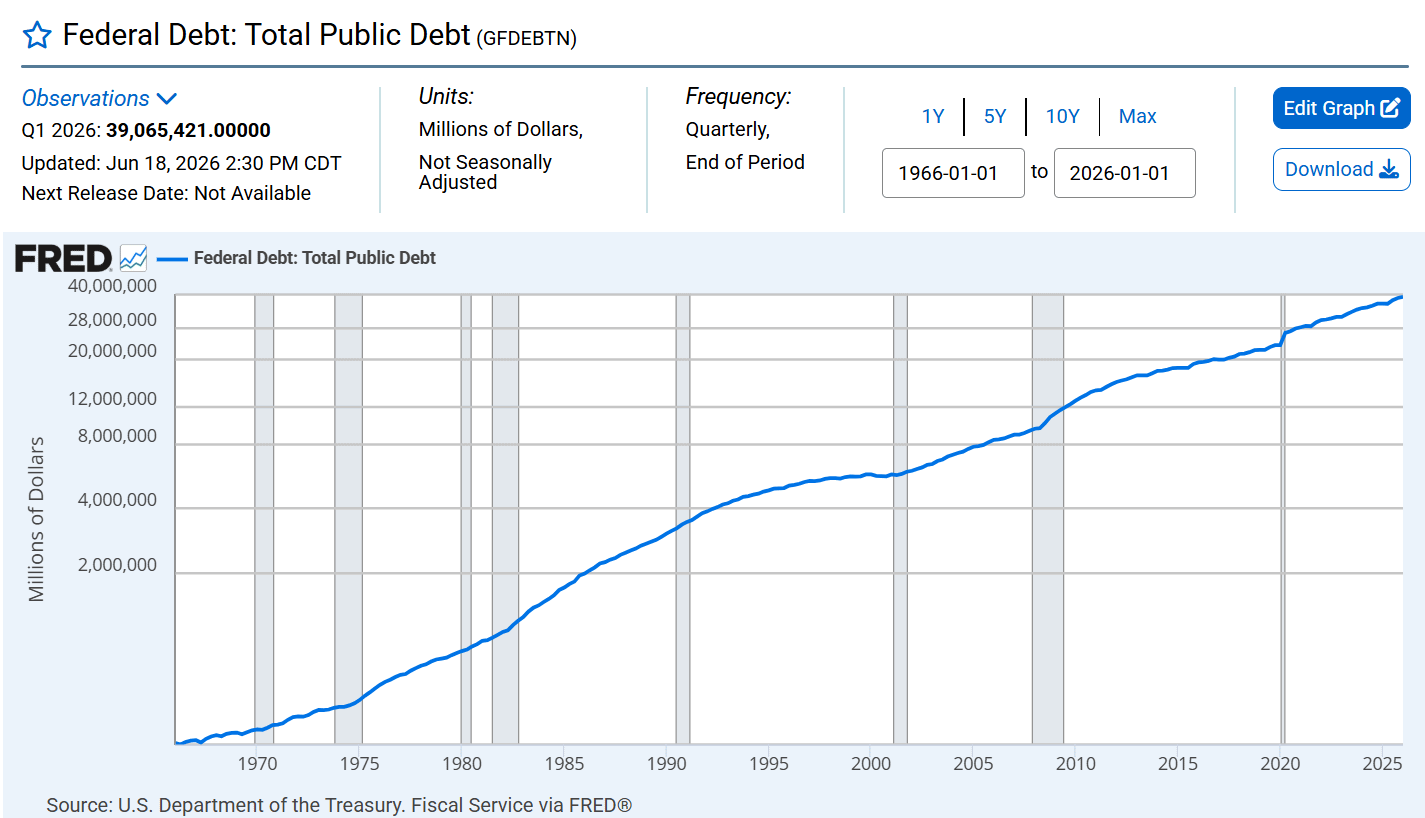
“In the U.S. we are running right now debt issuance - which is our deficit - at 7% of GDP. That is an insane number. It is an insane number given that we don’t have COVID, we don’t have a major recession. The United States economy is doing well. We’re growing around 2%. Unemployment is close to record low levels. There is nothing in history that for an okay period like we have right now and it is okay than for fiscal policy to be this profligate. It’s insane. So the United States is not alone in that. Something came unmoored in the decade leading up to Covid.”
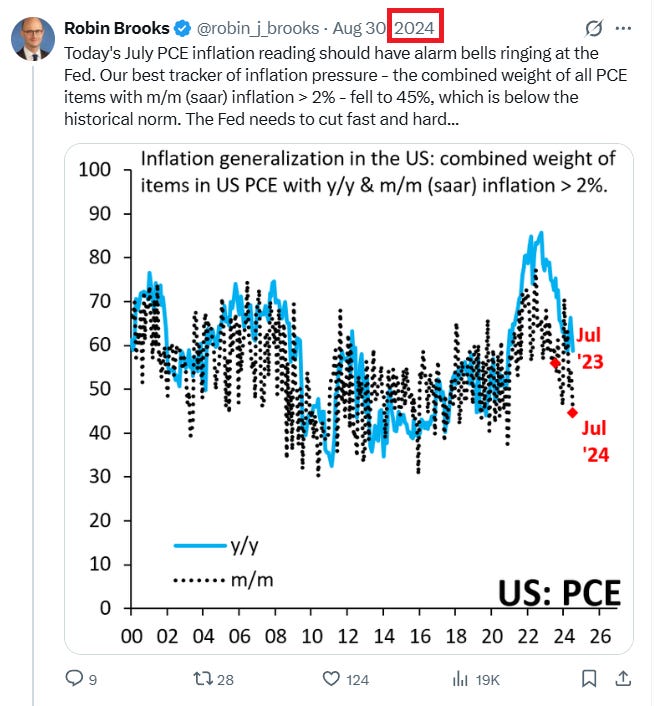
While agreeing with the above, I will note that I’ve noticed Brookings’ Robin Brooks over the years and been annoyed that he’s largely been a cheerleader for the insane monetary policies that have led us to a 7% non-recession deficit.
Headline of the Day
“People are worried about America’s solvency But not worried enough to actually do anything about it”
I will note that on CNBC on Tuesday some guy in a suit and tie said, “We're an interest rate insensitive economy."
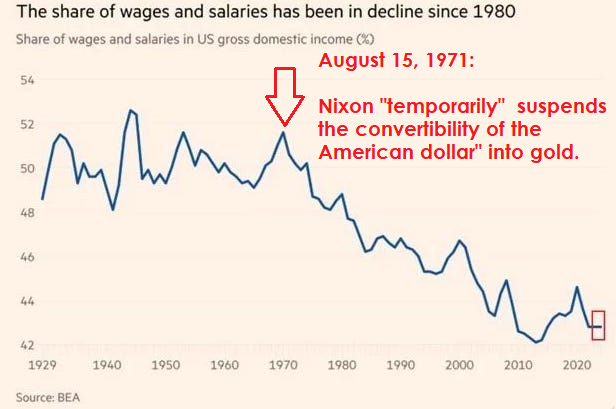
I know correlation is not necessarily causation, but I've seen so many charts that go off the rails once we removed all remaining monetary brakes and financialized everything, until only "the hyenas of economic life1 can come through unscathed."
e.g., This chart, of the shares of wages and salaries as a percentage of GDP, from a recent post:
“The real danger comes from encouraging or inadvertently tolerating rising inflation and its close cousin of extreme speculation and risk taking, in effect standing by while bubbles and excesses threaten financial markets.
Ironically, the “easy money,” striving for a “little inflation” as a means of forestalling deflation, could, in the end, be what brings it about.”
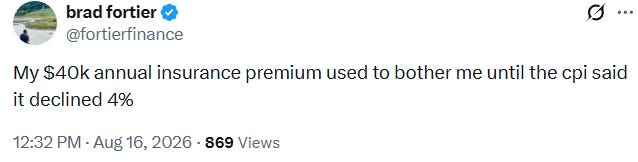
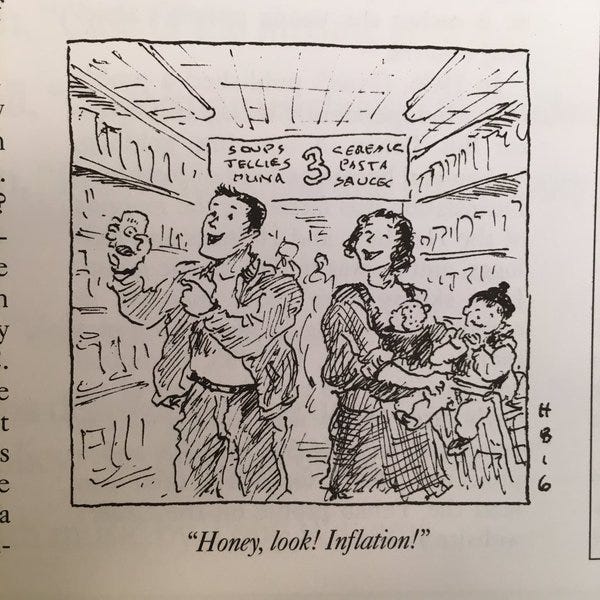
My monthly trash bill just went up 35%, and my sewer bill went up 73%, but it’s ok because the BLS says “Water and Sewer and Trash Collection Services” are only up 4.6% year over year.
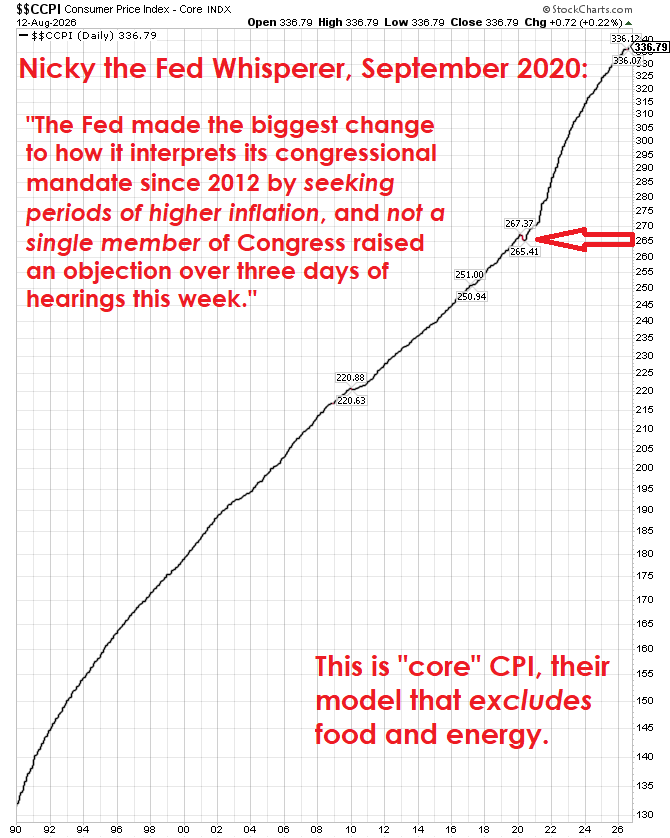
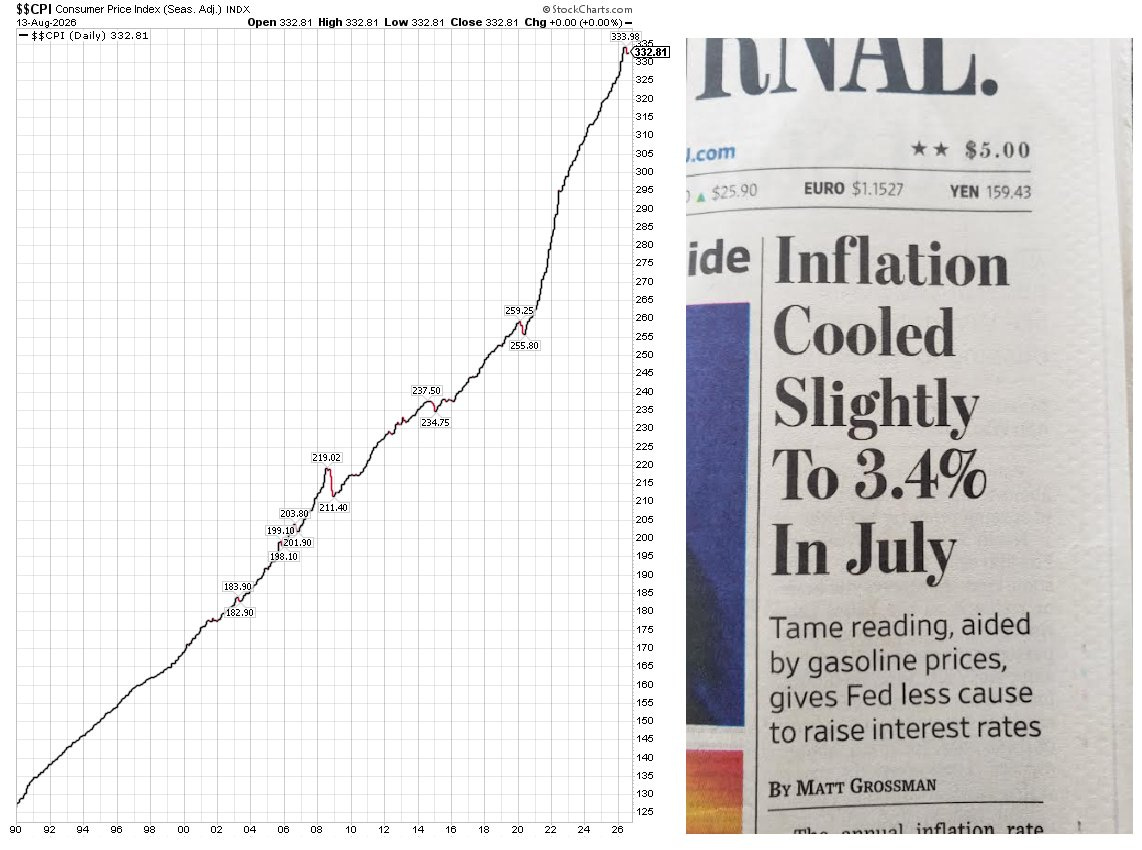
Anyway…it’s now over 5 years in a row of the Fed’s 2% “core” CPI model being well over target:
The gaslighting now is epic.
I understand that “inflation,” as used by most economists & their minions, generally means “rate of change,” but to normal people the word means “cost of living.” That is not “cooling.” Goofballs who smugly try to correct normal people on this - as if being above a B.S. made-up target for 5+ years is OK - are annoying.
From the WSJ: “Central Banks Are Stuck in a Rinse-and-Repeat Cycle of Crises”
The source of the problem is the switch from central banks being the lender of last resort to, in 2008 and 2020, also being market makers of last resort, ensuring corporate—and government—debt markets keep functioning. During a crisis, support is often essential to prevent a downward spiral that destroys the financial system.
But backstopping markets removes a key risk and encourages more borrowing—especially for the hedge funds that now own trillions of dollars of U.S. Treasurys.
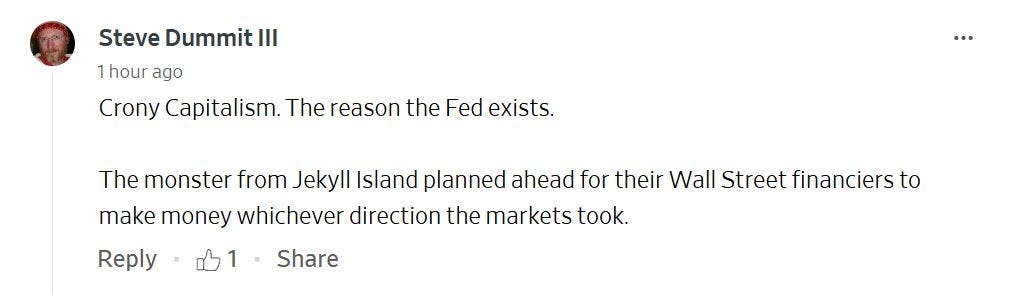
Gee, years of ZIRP and bailing out over-levered failures encouraged more risk-taking?
No one could’ve seen this coming.
"Credit card balances rose by $21 billion to stand at $1.26 trillion, and auto loan balances increased by $28 billion to $1.71 trillion."
Sentimental Journey
“Decreases in sentiment were seen across the political spectrum, with Republicans exhibiting the strongest month-to-month decline in August. Sentiment among Republicans is now 19% below readings just prior to the Iran conflict and the lowest since the 2024 election.”
“Although the early-month weakening in sentiment was pervasive across various demographic groups, notably large reductions were seen among older consumers, lower-income consumers, and those without a college degree. These groups are all particularly vulnerable to any erosion of purchasing power stemming from inflation. Across all consumers, only 8% expect their income growth to exceed inflation in the year ahead”
Home Prices
The SuperGrok tells me the average household income in the U.S. is $114K and the median is around $83K.
Using the old 3x-income rule of thumb that’d support a house price of $249K to $342K.
“In July of 2026, multifamily posted the largest increase in delinquency and now stands at a 7.69% delinquency rate, up 46 basis points from June. While the current level of distress is much higher in office at a 11.91% delinquency rate, multifamily now makes up $2.32T of the $5T in outstanding commercial real estate debt…Office got all of the attention with splashy headlines, but based on the research we have done here, it looks like multifamily may end up being an even bigger story when the ink finally dries on this cycle. And, remember, you’ve got a lot of government-sponsored debt sitting behind multifamily…about $1.2T of it.”
More stable prices: Commercial rents last year rose, with office rents surprisingly(?) up 9.6% year-over-year. As of June 2026:
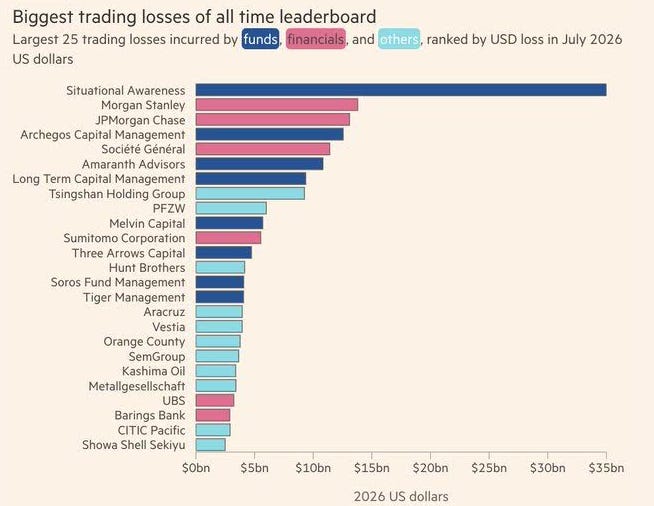
(See this post on ‘Situational Awareness’ from a couple weeks ago.)
“The funny thing about it was I didn’t know who he was from Adam. I never heard of it [Situational Awareness.] I’m 54. I don’t know the New Whiz Kids. I hear of them, and I know some of them. And I was just told how much of a genius he was, right? He was valedictorian, right? Did some crazy speech. My younger-folk friend would tell me how brilliant it is. And I just assume he is.
But then I look at his portfolio, right? I’m like, “Oh, you were just long A.I.” But levered, right? I don’t know what sheer utter brilliance that took. I’ve seen this story before many times. I guess he missed the risk management course in his brilliance in terms of leverage. That leverage can put you in sticky situations that you do not want to be in.”
“You can’t rely on it for research because it will get a subtle thing wrong. And a subtle thing wrong will break everything. People don’t realize this with knowledge. People don’t realize this with history. People don’t realize it. These little bits, these little subtle things that we believe make up the foundation of our knowledge. And LLMs they don’t think because they are probabilistic even at their most complex levels. They don’t have the ability to catch their own mistakes every time. And it does need to be every time. And people will say, “Well, that’s an unfair standard.” I’m not the one asking for trillions of dollars.”
“I don’t think it replaces jobs. I think don’t think it will replace jobs. I think the bloke from Citadel [Ken Griffin] is nuts. I think that all of the banking people who are claiming this is happening don’t know what they’re doing, and shouldn’t be allowed to touch money anymore. I think it’s a joke.”
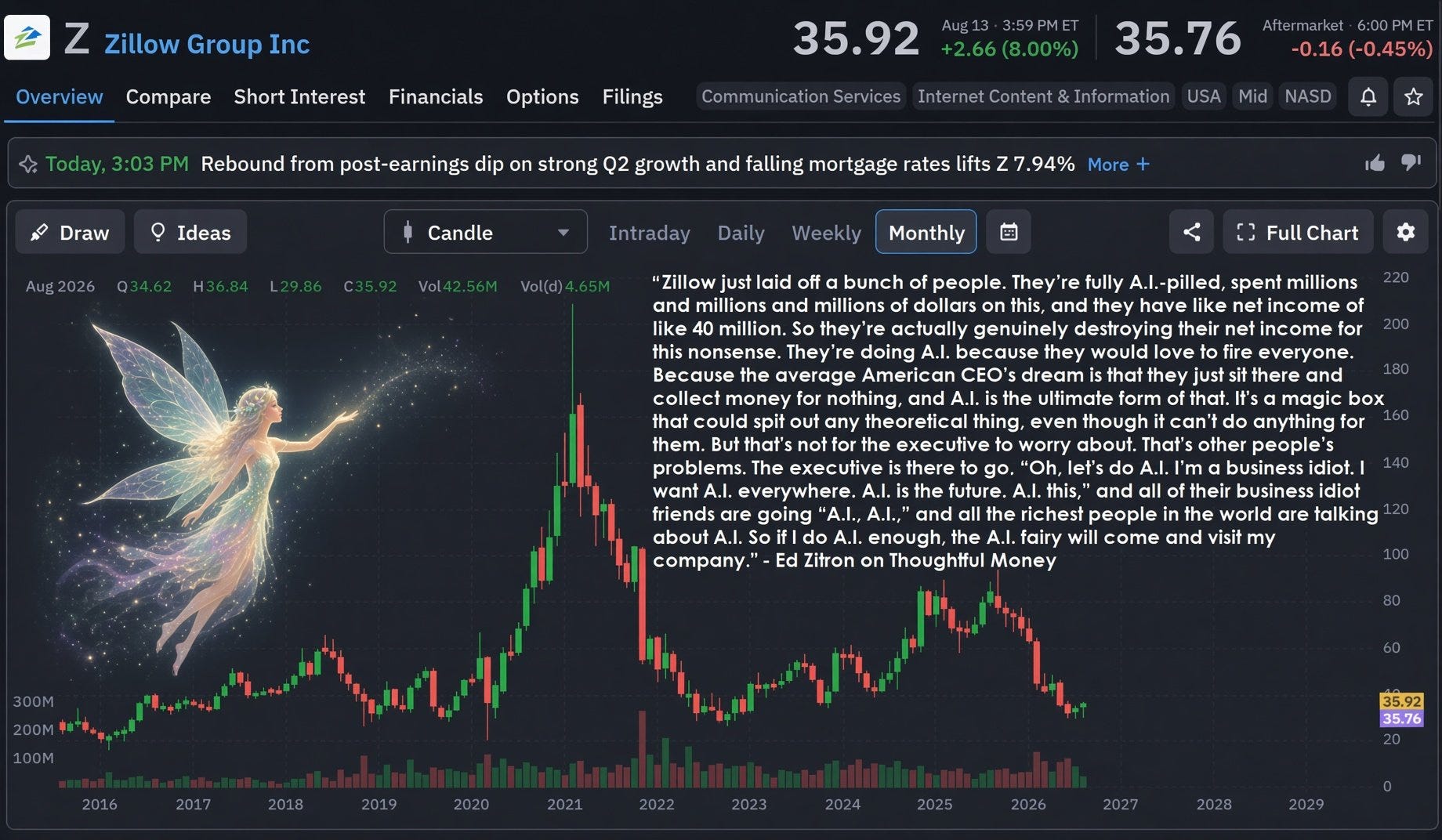
“Zillow just laid off a bunch of people. They’re fully A.I.-pilled, spent millions and millions and millions of dollars on this, and they have net income of like 40 million. So they’re actually genuinely destroying their net income for this nonsense. They’re doing A.I. because they would love to fire everyone. Because the average American CEO’s dream is that they just sit there and collect money for nothing, and A.I. is the ultimate form of that. It’s a magic box that could spit out any theoretical thing, even though it can’t do anything for them. But that’s not for the executive to worry about. That’s other people’s problems. The executive is there to go, “Oh, let’s do A.I. I’m a business idiot. I want A.I. everywhere. A.I. is the future. A.I. this,” and all of their business idiot friends are going “A.I., A.I.,” and all the richest people in the world are talking about A.I. So if I do A.I. enough, the A.I. fairy will come and visit my company. And I think it actually is the dreaded hand of neoliberalism.”
“This is a manipulated market. It is a market that is disconnected from business fundamentals, driven mad by AI.” - Zitron
I will note that I spoke with two small businessmen the other night and both used A.I. to automate various office tasks, so they definitely felt A.I. (or whatever it is) has helped them.2
I want this on the record, with a date on it: July 17, 2026. Apple is the number one, undisputed king of AI right now, and almost nobody knows it. NVIDIA is a dead man walking…
The endgame of AI is not four companies renting you intelligence by the token from a datacenter in Virginia. The endgame is intelligence as a commodity — models good enough for 95% of everything, free to download, running on hardware you own, answering to nobody. Every historical technology wave ends the same way: the mainframe becomes the PC, the timeshare becomes the laptop, the cloud becomes the edge. The only people who ever argue otherwise are the people selling mainframes.
Therefore the right question isn’t “who has the best model?” It’s “when the models become free, whose hardware do they run on?”
Thomas Hayes
“The problem is, in normal lending, if you don’t get paid, you take the asset, you take the manufacturing company, you take the factory line, you take the inventory, you take the house in the case of a mortgage. In this [A.I.] case, what are you going to take? You’re going to take a semiconductor chip that is 5 years outdated and already has significant use on it and may be obsolete?”
“If I lend on a a house that’s overvalued today and I get it wrong, and the housing corrects 20%, it’s still a productive asset in 15 years from now. If I got to take it back, I’m going to probably make money when I liquidate the thing. You cannot make the case if I lend on a 2026 vintage Nvidia GPU in seven years it’s going to be worth more than it’s worth today and I’m going to get my money back. You cannot. They’re going to sell that story, but it ain’t going to be true. I can tell you that 100%. Bet the bank on it.”
Dan Oliver: A.I. Debt Failure Will Prompt Another Wave of Fed Bailouts
“…when the 1960s bubble began to pop in its turn, Fed chairman Arthur Burns began extraordinary interventions to keep the bubble alive. Every time a major bank or company threatened to fail—Penn Central in 1970 or Franklin National Bank in 1974—the Fed would take it as a signal that rates were too high and would therefore lower them. Rates set low enough to save impaired businesses were far too low for the general economy, and inflation became an increasing problem.
Volcker arrived at his post in 1979 with a mandate to slay inflation. He announced a change in policy in that he would raise rates as required to reduce the growth in money supply. He jacked the fed funds rate above 19%, which did help end the inflation amidst a terrible recession, though there were other structural reasons, including overcapacity constructed during the inflationary 1970s, the Soviet Union dumping commodities into the market in an effort to survive, technology causing the measured prices of some goods to plummet, women and then Chinese and then third-world immigrants entering the global economy reducing labor rates.
In early 1984, M2 money supply was still growing above 9% per year, but then Continental Illinois National Bank failed. Several Federal Reserve governors had wanted to raise rates despite the Reagan team’s vigorous objection, but Volcker warned the FOMC: “Continental is probably manageable with difficulty; $40 billion institutions are difficult to manage. Having two or three $40 billion institutions is a horse of a different color. If we have two or three, I don’t think we’re going to stop at two or three.” Continental’s equity holders were wiped out, but its uninsured general creditors, who had benefited from well-above-market returns for a decade, were bailed out completely, and the Fed dropped rates to help other troubled banks…
The Fed’s core mission was to protect the banking system no matter how reckless its loans, and Greenspan took that mandate a step further: if the banks were functioning properly, there should be economic growth, and if there is economic growth, then the stock market should be rising, so the best way to gauge the credit system was by looking at the Dow Jones Industrial Average. This is what 1987 taught him. “I’m always worried about the stock market,” Greenspan admitted on the television with David Brinkley. “Every day, every hour?” “Yeah.”
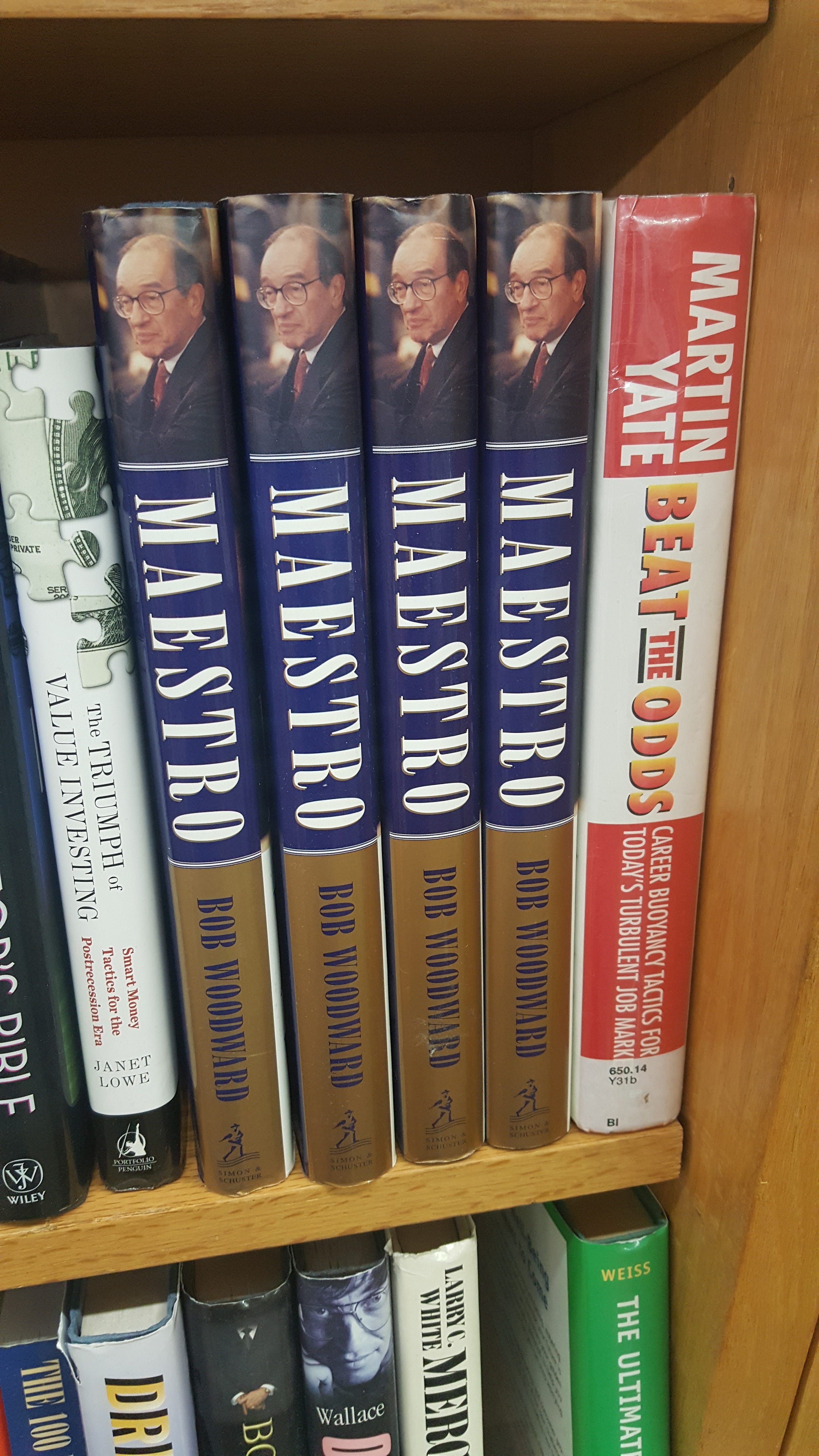
And thus was born the Greenspan put: the Fed would allow the stock market indexes to fall only so far before interpreting the fall as a sign that rates were too high and injecting newly printed money into the banking system to lower rates. From the end of 1994 to the end of 1999, the Dow Jones Industrial Average gained an average of 24.6 percent per year. The press called Greenspan “The Maestro” for his ability to levitate stocks…
At his swearing in ceremony, Warsh proclaimed: “Chairman Greenspan was the first to tell me and show me what this role demands.” One thing Greenspan did was shift the Fed’s preferred measure of inflation from the CPI to the PCE, which generally runs well below the CPI, another reason why Greenspan could argue that inflation was too low and, therefore, rates too high. Recently, the PCE has been running above the CPI, so the Wall Street Journal reports that Warsh will: “‘evaluate new information sources and consider methodological changes’ to give policymakers more ‘actionable’ readings on the economy.”
“Second, just as Greenspan kept rates low because he erroneously believed that technology was causing productivity gains that required printing more money to maintain stable prices, Warsh wrote in the Wall Street Journal: “AI will be a significant disinflationary force, increasing productivity and bolstering American competitiveness.” He has been using this argument in presentations to support Trump’s assertions that interest rates need to be lower now…”
[Dan spends a lot of time writing about investment in A.I. - too much to excerpt here. Check out the entire article if interested.]
“The AI risk sits with PE investors, especially insurance companies, which introduces systemic risk. Insurance companies faced with Bernanke’s low interest rates post-2008 had to reach for yield and became natural buyers of high-yield, high-risk private debt. The PE funds that create and issue private debt soon realized that the best way to force more deal flow through the insurance companies was to buy them outright…
Burns, Volcker, Greenspan, Powell all joined the Fed with new, optimistic theories on how to run the central bank and choose the correct interest rate for the country while controlling inflation. The market swiftly tested each of them with market crashes and bank failures. They folded. They had no choice. The interest rate necessary to support malinvestments and fund the government is also the rate that is too low for the rest of the economy, and the government will always choose the policy that supports the banking system over that which maintains the value of the currency.”
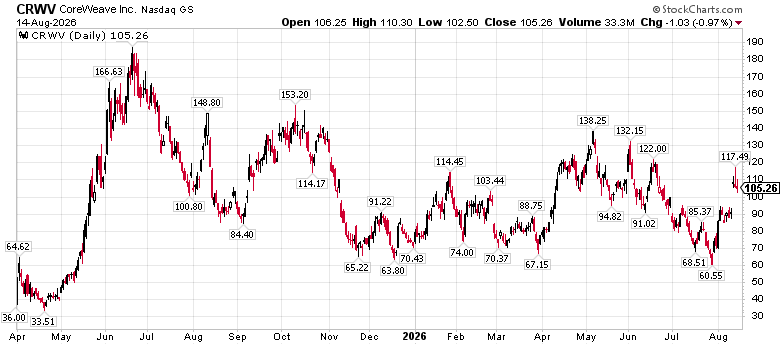
Interesting article on Coreweave
“On July 29, credit default swaps on CoreWeave debt priced a 50% five-year default probability, a premium level normally associated with deeply distressed borrowers. Not a company that was rocketing to revenue highs. Credit markets are pricing CoreWeave like a company on the brink, while stock markets are looking at it like a rocket ship. That’s not a great sign.”
I have no position, it just sounds sketchy, as Nobody Special has mentioned for a couple years.
An article sent to me on Mark Walter, who owned the Lakers for only 14 months:
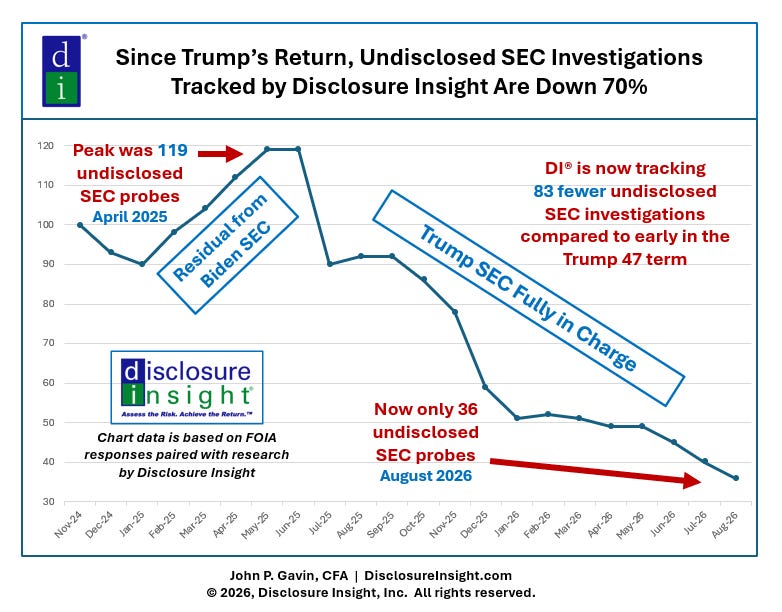
“a pioneer in using insurance capital to invest in private credit, a form of nonbank lending to businesses that has grown rapidly.” But lately, that’s been the whole problem. As Walter and his ventures are being investigated by various authorities for possible loan fraud and fiduciary self-dealing”
I bet he’s not the only rich guy this describes…The really odd part is that he’s actually being investigated.
I read this actual investigative journalism from Nick Nemeth (via Mike Green): The Numbers Person : Dan Towriss, operator of Mark Walter’s insurance group which holds $76 billion in annuity assets for half a million policyholders.
777 Partners and the End of Private Credit
“…The scale of the financial collapse of 777 Partners is truly epic, yet very little notice to this massive default has been paid outside of the specialty media. Yet the Miami-based private equity and alternative investment firm has actually received intense, sustained coverage across global financial, investigative, and sports media outlets—particularly regarding its multi-club soccer network, the failed takeover of Everton FC, and subsequent collapse…
We believe that the unwind of 777 Partners and the literally hundreds of affiliates involved in this fiasco provides a picture of how the private credit trade is going to end. Millions of retirees who depend on life insurance and annuities could be affected by unsound management practices by private credit and equity managers who care only about profits.”
Sadly, I think white collar crime above a certain number of zeroes has essentially been legalized.
Kevin Muir:“Can I just understand this correctly? The leading left candidate [in France] has openly said his solution to solving the debt or the deficit is to not pay interest??
Vincent Deluard: “Mathematically it works!”
Greg Weldon
“Social security, for example. You take money from new investors, new taxpayers, to pay off the old investors who are cashing out. The retirees want their entitlements and their benefits, right? This is the definition of a Ponzi scheme.”
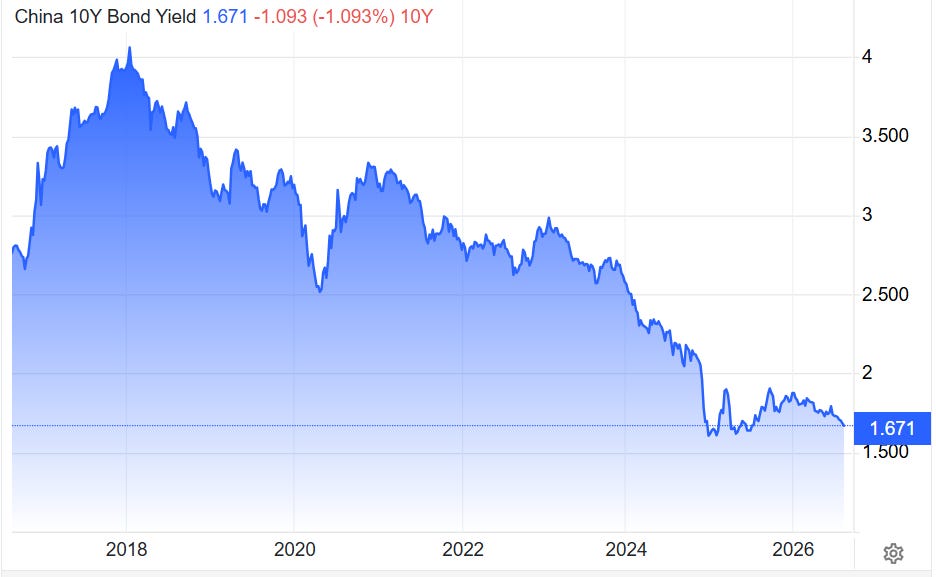
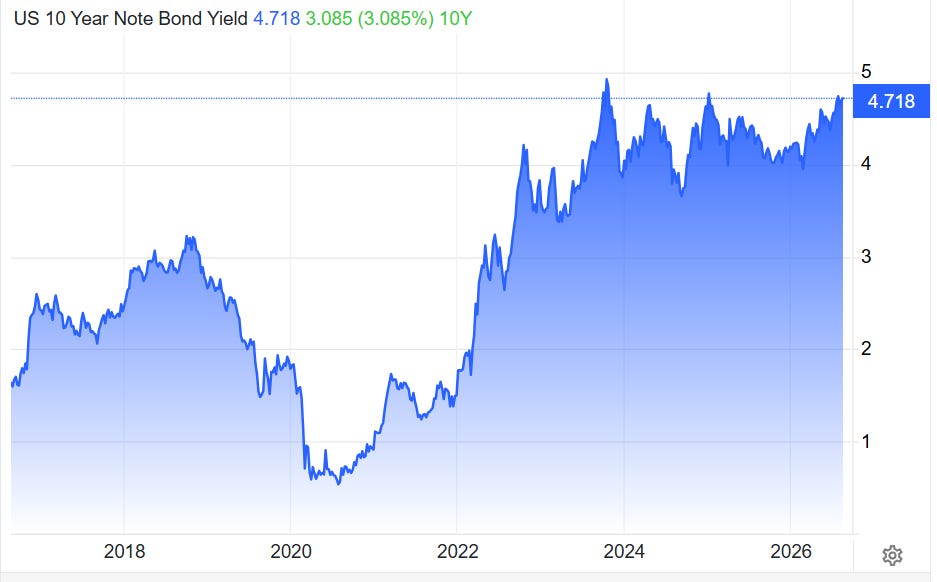
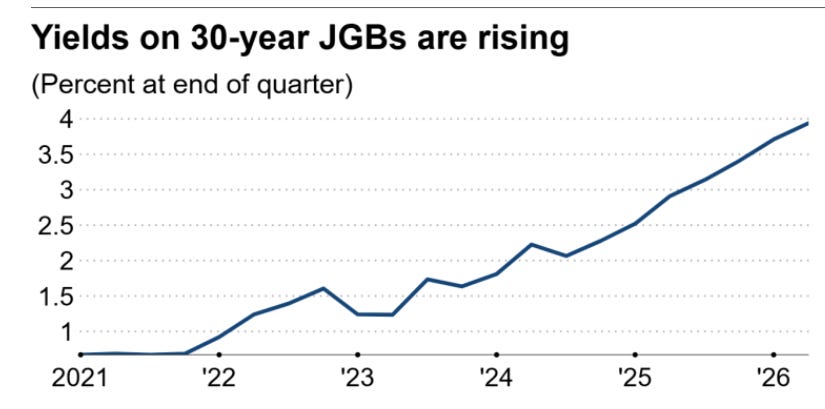
“When staring into a debt deflation abyss, every central banker on the planet will choose to reflate at any cost, and that reflation comes usually at the expense of the currency,. ok? And this is why Bessent spent $9.5 billion of U.S. taxpayer money to bail at the Yen. Why? because you have an 18-year high in the U.S. bond yield, the 30-year bond yield, okay, well above 5% now. You have 60 trillion in debt. You have a trillion interest payments. And you have Japan as the largest international holder of US debt at $1.2 trillion worth.”
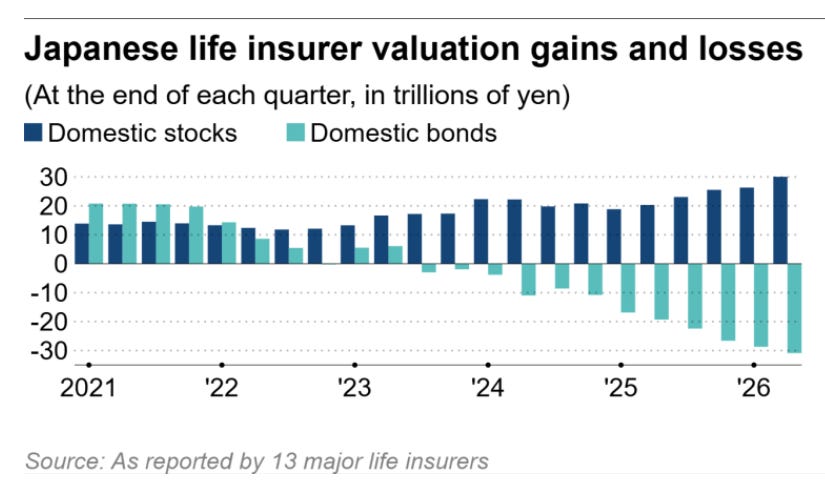
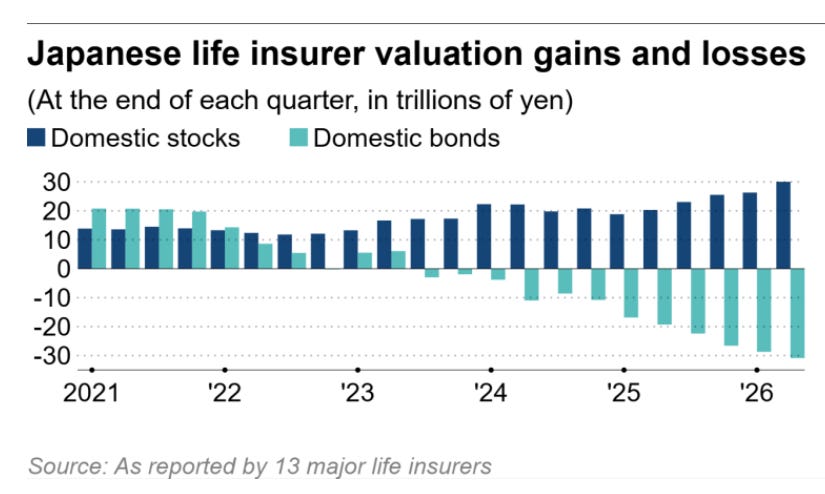
Unrealized losses on domestic bonds at Japan’s major life insurers have soared to 30.86 trillion yen ($194 billion) as of the end of June, up 60% year-on-year, revealing the downside of the rising interest rates that have lifted investment income.
Nikkei compiled the figure from the 13 respondents out of 14 major life insurers surveyed. The total surpassed their unrealized gains on domestic stocks, which were up 48% to 30.03 trillion yen…
If the market value of a bond falls 50% below its acquisition cost, insurers may be required to recognize an impairment loss.
I assume the problem of impairment losses can be fixed simply by removing the requirement to report them!
The debate about the food aboard the Lincoln and now the George Washington is largely a red herring. Arguing about food substitutes an emotional argument for a stark practical one. The real issue is how the war on Iran is burning through equipment and people. I.e., now the Lincoln, along with the Ford, will most certainly undergo maintenance for an extended period because of the length of their deployments in support of the war in Iran. Those deployments will also hurt retention (this was a major issue during the Iraq War in particular; remember stop loss?) And the question is: for what? It’s not like they were chasing the Imperial Japanese Navy across the Pacific following an attack like Pearl Harbor.
Now the Administration, despite all the warnings about Taiwan and a China-focused National Security Strategy, is moving our only carrier out of the Pacific. This is a major strategic signal, coming on the heels of news that we’ve burned through other major capabilities such as interceptors, radars, stand-off munitions, and a large chunk of the MQ-9 fleet, among other things.
It is clear that the Iran war is not only detrimental to US national security, but a potential strategic blunder worse than Iraq if we don’t cut bait; and this is the conversation pro-war types want to avoid at all costs.
“The aircraft carrier U.S.S. Abraham Lincoln’s supply problems began soon after the first day of the war, as Iranian missiles and attack drones fell on a Navy base in Bahrain.
The Iranian attack, retaliation for the U.S.-Israeli assault on Tehran, destroyed much of the base. And as it went up in smoke, so did a major logistics hub that the Navy has relied on for decades.
The Navy needed a Plan B to continue feeding the sailors working around the clock to keep warplanes flying strike missions, and later to maintain a blockade of Iran’s ports.
With the threat of Iranian attacks at other ports in the region, the Pentagon looked to a base under British command on the island of Diego Garcia as its supply hub, which is south of the Maldives and roughly 2,200 miles from where two aircraft carrier strike groups have been operating in the Gulf of Oman.”
Scott Horton: “Israel’s slaughter in Gaza is the major radicalizing factor for a whole new generation of Bin Laden-like terrorists that threaten the United States.”
Joe Kent:“The Saudi jihadis, the al-Qaeda and the ISIS, they want to come here or inspire attacks here in the homeland to hit us here. Previously the Iranians, the Shiites, they had not wanted to do that. They would attack us when we go into their region, but they would not come here and attack us.”
“Anonymous photo posted online recently showing some “artwork” on the right wing flap of a U.S. Air Force KC-135R Stratotanker deployed to an undisclosed location in the Middle East...”
"AI has become my reading buddyas I’ve plowed through my summer book list, helping me keep track of plots and characters, unpack themes, and make sense of wordy, old prose.
Why it matters: The way many of us actually read books — a few pages before bed, a chapter at the beach, another on a plane — makes it easy to lose the thread. AI can help you pick it back up without starting over.
📖 I really got into using AI while reading James Fenimore Cooper’s “The Last of the Mohicans.” The text was far too dense for casual vacation reading. My first prompt asked:
“I’d like a guide as I read The Last of the Mohicans who can help me understand what I’ve read and where the story is, without giving spoilers or getting ahead of my progress. Can you do this, chapter by chapter?”
The robot agreed: “Cooper’s sentences are long and his diction is archaic.”
It promised to give me “a recap of what’s happened so far and clarify anything confusing. ... I’ll stick strictly to what you’ve read. No hints about what’s coming.”
🔖 That’s now become part of my reading routine: Tell AI where you stopped and ask for a spoiler-free recap so far, which often surfaces details I’d missed or forgotten.”
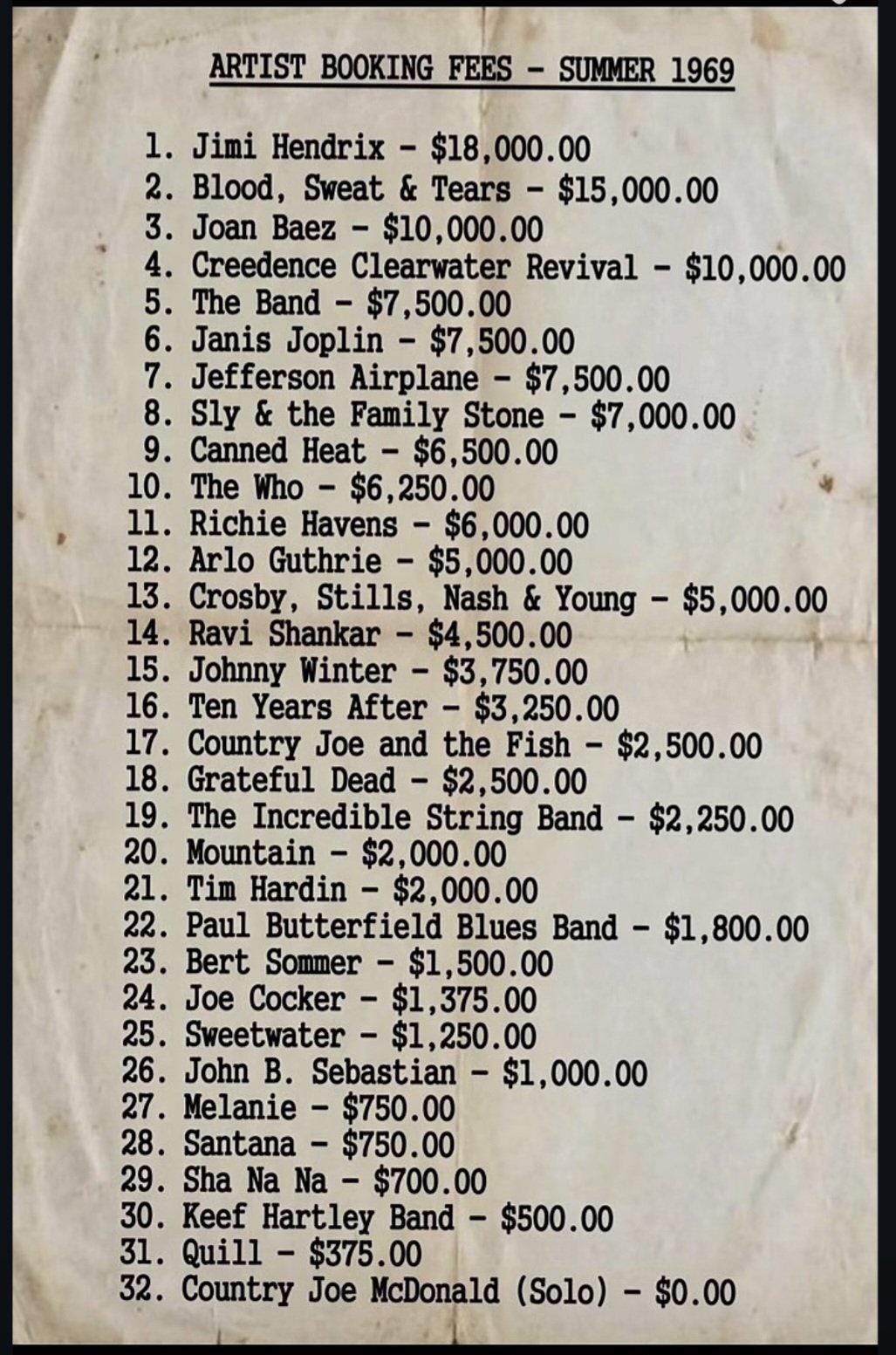
Woodstock Booking Fees
This was put up at the University of Southern California in 2018:
For posterity, here’s a good 2018 op-ed (by an anti-capitalist Pagan “Jungian Life Coach”!) I’d saved, on identity politics:
“sitting in a café on lunch break from my former job as a social worker for homeless people a man told me this:
“The only good white men are the ones who know they should be shot in the face because all they are capable of is harm.”…
as the once-strong movements of social justice dwindle into ever more isolated cadres of intersectional elect, their fascist shadow looms ever larger, equally obsessed with the white phallus. Yet fixation on genitalia and skin-tone are not their only shared trait, for they both cling deeply to what their masters taught their ancestors. Do not work with those not like you. Blame your suffering on symbols and skin. Purify yourself to be made holy and worthy in the eyes of your lords, who wield over you the power of life and death as they collect your rent and dole out your wages.
As that fascist shadow looms larger, claiming more and more people told by social justice activists that their skin color and c*cks make them innately, irrevocably evil”
“Before, I was a witch-hunting communist out to steal people’s gods. Now, I’m a crypto-fascist white nationalist out to lead astray the devoted from the churches of social justice…I am hardly surprised that some American devotees of identity politics find it offensive. Some apparently have not yet discovered that there are leftist critiques of identity politics (and thus assert I must actually be a fascist), while others make qualified admissions that there are problems with American social justice but there is still something deeply dangerous about my words.
The essay directly challenges what I consider to be the crucial error of liberal identity politics. That error: it classifies males and whites in an alpha-oppressor class in order to outline hierarchies of oppression. That is, “white, cis- heterosexual able-bodied men” are the cause of the oppression of all others within capitalist society because of the privileges granted humans within those categories…
Such a critique runs counter to all the dogma of American social justice politics, where each person is to dismantle or at least “check” their privilege in order to build a better, more fair and “socially-just” society. But of course the people running Goldman Sachs don’t have privilege–they have power, and wealth, and also much more say over who gets oppressed than some white male construction worker who will never read Judith Butler.”
“…on an average day in 2023, one in 10 young Americans aged between 23 and 29 did not spend a single minute interacting face to face with another person.”
“Despite $30–40 billion in enterprise investment into GenAI, this report uncovers a surprising result in that 95% of organizations are getting zero return. The outcomes are so starkly divided across both buyers (enterprises, mid-market, SMBs) and builders (startups, vendors, consultancies) that we call it the GenAI Divide. Just 5% of integrated AI pilots are extracting millions in value, while the vast majority remain stuck with no measurable P&L impact. This divide does not seem to be driven by model quality or regulation, but seems to be determined by approach.
Tools like ChatGPT and Copilot are widely adopted. Over 80 percent of organizations have explored or piloted them, and nearly 40 percent report deployment. But these tools primarily enhance individual productivity, not P&L performance. Meanwhile, enterprise grade systems, custom or vendor-sold, are being quietly rejected. Sixty percent of organizations evaluated such tools, but only 20 percent reached pilot stage and just 5 percent reached production. Most fail due to brittle workflows, lack of contextual learning, and misalignment with day-to-day operations.”





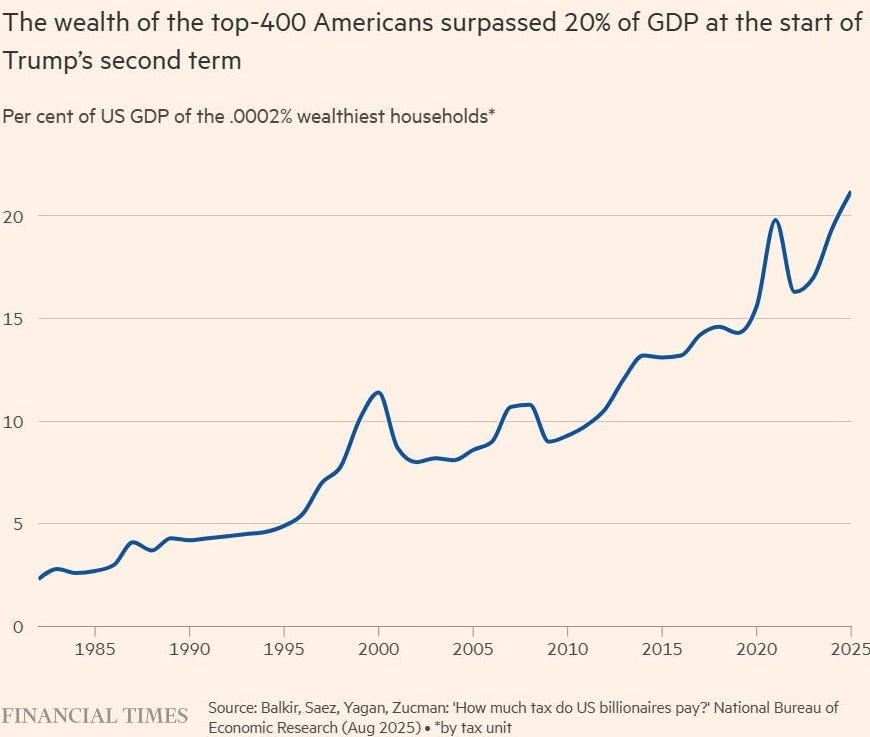
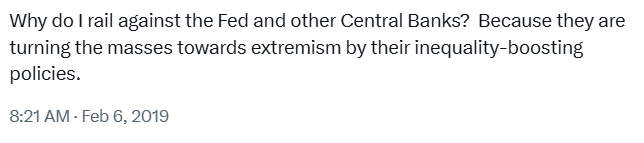
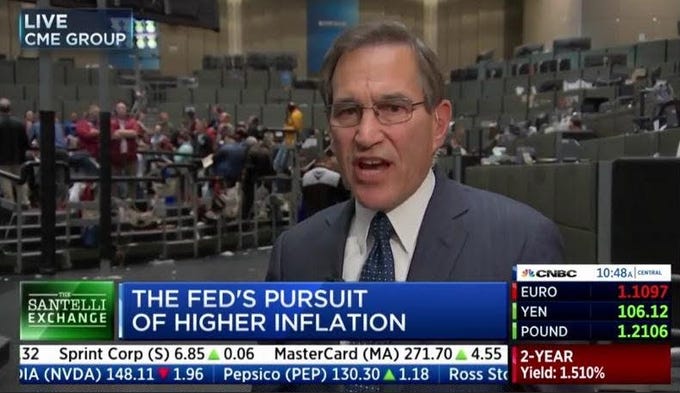
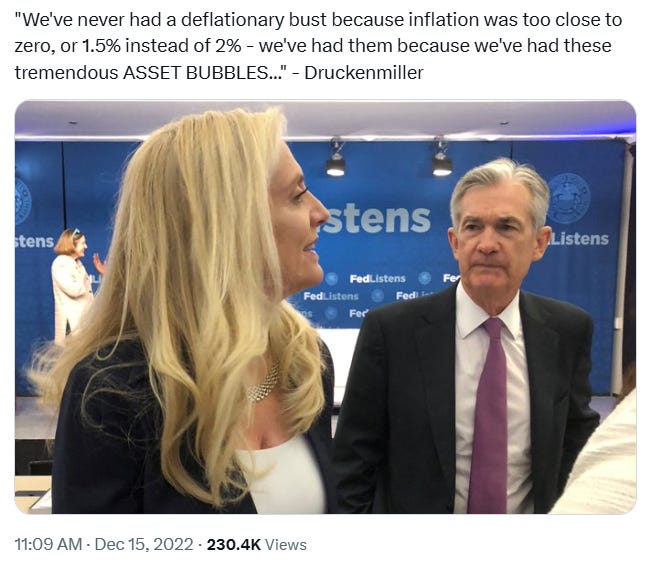













Each day I'm watching someone else I used to admire/respect turn into a looter of the current system. It's exhausting. Thank you for the mention.
we are deep into the looting stage of empire collapse.