All roads lead to inflation
And nobody’s protected from inflation.
“All roads lead to inflation.”
Christopher Waller, Jim Bullard’s Mentor:
We’ve now been above the Fed’s made-up 2% CPI target since April 2021, forty-three months.

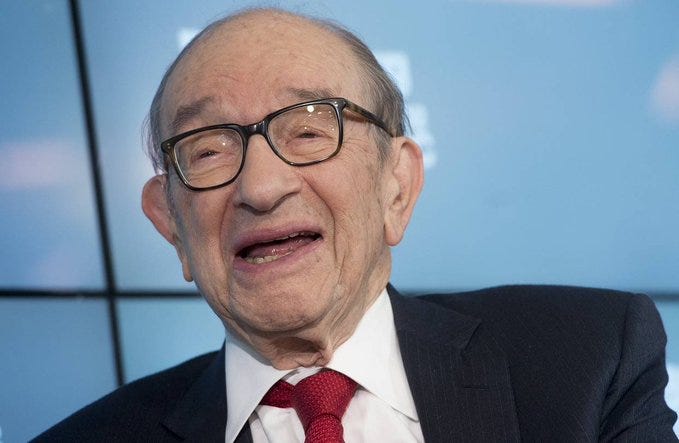
Here’s Alan Greenspan laughing in 1996 about juking the inflation numbers…
"...we can reach price stability either by driving down the inflation rate and getting productivity to bounce up or by revising down the inflation figures and producing higher productivity! [Laughter]"
Alan Greenspan, July 1996 FOMC Minutes
Via GoldTelegraph, Judy Shelton:
Rules are for the Little People
Remember when Silicon Valley Bank failed, and uninsured (but connected) billionaire entities like Sequoia Capital1 ($1B) and Kanzhun, a Beijing-based tech company ($900M) got paid in full?
Newsflash: If you're some random American banking at First National Bank in Oklahoma, get in line. The rules do apply to you.
Remarkable, prescient exchange from March 2023. The reprehensible Janet Yellen admits Peter Thiel's personal uninsured $50 million at SiliconValley Bank & the Chinese Communist Party's uninsured deposits will be bailed out by Oklahoma community banks, but no bailout for Oklahomans.
Rules are for the little people.
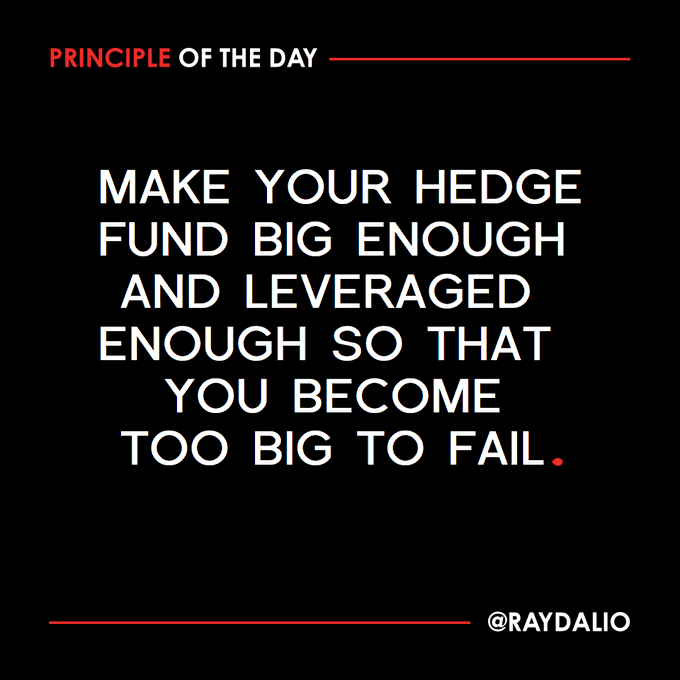
Below the fold are the thoughts of Chris Whalen, David Dredge, Paul Tudor Jones, Jeff Currie, Anna Wong, Scott Bessent, Russell Napier, and others, plus Dogecoin, things that may be overpriced, looming inflation, Michael Pettis, David Einhorn, Tony Bennett, Bob Dylan, coffee, capital controls, and more fun.
Are you not entertained?
Chris Whalen
Buying trillions of dollars in securities and losing hundreds of billions in taxpayer funds is a fiscal operation
“Fed chairmen like Arthur Burns and Paul Volcker once lectured Congress about budget deficits, but not in the age of “big” liquidity and de facto fiscal policy by the FOMC. Buying trillions of dollars in securities and losing hundreds of billions in taxpayer funds is a fiscal operation, whether or not the Fed or Congress care to recognize it. Will President Trump hold Jerome Powell responsible for the results of the Fed's hedge fund?
The Fed will continue to lose money on its portfolio for years to come as trillions of dollars in mortgage-backed securities purchased by the Fed Board under Chairs Yellen and Powell linger. Since the 10-year Treasury is the indicator of solvency for US banks and also the reference for residential mortgages, the fact of a 4.3% yield is not welcome news. The Mortgage Bankers Association has just pushed down loan production estimates 10% for 2025 to just $2.1 trillion. That figure may yet fall lower if LT Treasury yields rise further.
There was a funny article in Bloomberg at the end of September lauding the US banking sector for dodging the bullet on unrealized losses, but this was before the 10-year Treasury backed up 75bp in yield through October. If as we suspect the Fed eventually drops short-term interest rates, the long end of the Treasury yield curve may rise, exacerbating the trillions of dollars of losses hidden inside many US banks, and also private equity and credit funds.”
"The reaction function of policymakers here is to stop the US 10-year crossing 5%, as simple as that."
“a 10-year Treasury at 5% yield - alarm bells will be going off” (I will insert Jim Grant’s quip here: "It was the zero-percent era that made a 5%-plus rate dangerous.")
Lin: “Why are markets pricing a higher risk of us debt versus Berkshire Hathaway?” Whalen: “Because of liquidity I think.”

“We've been on a fiat system, so we can't tolerate competition. We have to get rid of the competitors. The Chinese understood this immediately. That's why they banned crypto in China.”
“The Yellen treasury was hiding from the deficit by doing nothing but T-bills, which I think was irresponsible. In 2020, Janet should have been issuing a lot of long bonds. The market was paying you to do it, and they missed the opportunity.”
“Janet Yellen really had no brief as far as finance or the markets. She was totally lost. She was much more comfortable talking about global warming,
so I think that Bessent is going to help the U.S…”
“You want to help people reduce gasoline consumption? You want to be
ecologically sensitive? Get a hybrid. It's much more practical for your family.”
“The Fed should take their mortgage paper, slice it up in the collateralized mortgage obligations - you know. the old CMO model - and sell them. They can keep the tails, they'll keep the high-risk stuff, and maybe they hit a home run if long-term rates fall and Trump reduces the deficit. Then Jay Powell could hold his head up high again, and he won't have to worry about the $250 billion losses so far. Those are real losses by the way.”
“That's why Warren Buffett got out of Bank of America. He could do the math.”
Lin: “Should we worry about inflation coming back?” Whalen: “Yes.” Me: “Inflation never left.”
“Why wouldn't you sell fiat dollars and buy gold? To me it's the obvious trade…frankly, I think gold is dramatically undervalued. If I were at the US Treasury, I'd be buying gold until I got it up to $100,000, because I think the rate of inflation in the US since Roosevelt's arbitrary peg at $35 has been much, much higher than the price increase in gold”
David Dredge: Risk Update: October 2024 – “Kayfabe”
““Sharpe World” trained economists and central planners have a knack of, at best, looking for first-order effects in their efforts to direct economies and markets. However, they operate with seemingly total disregard for unintended consequences, negative externalities in economist-speak, ignorant to the reality of Butterfly effect dynamics in complex real-world systems.”
“This brings us back to our regular refrain – they don’t know what the impact of their interventions will end up being. More accurately, they can’t know.”
Dredge:
“Whether it was their intent or not (we think it was), the immediate result from the central banking era of the Greenspan Put has been the expansion of money and credit (classical inflation), leading to the inflation of asset prices and, if it works, to inflation of consumer prices. This naturally leads to destabilizing wealth segregation and eventually socio-political fragility – aka the Cantillon Effect.”
Dredge mentions this exchange with Sorkin and Paul Tudor Jones:
ARS: “Life is relative, as some people say. Sure, you can either buy bonds from the US or you can buy bonds from somebody with even a worse situation”
PTJ: “Or you can not buy bonds at all”
An Economic Kayfabe
Paul Tudor Jones: “There's a term that I'd never heard of, called kayfabe, and in wrestling parlance, that represents the unspoken, unwritten, tacit agreement between the wrestlers and the fans about the illusion that's going on in the ring, the suspension of disbelief that was going on the ring is actually - we know it's scripted, and we know it's a performance - but they ask us to think it's genuine and real.
Paul Tudor Jones: And so we're in an economic kayfabe right now. And it's not just the United States. We're in it in the UK and France, Greece, Italy, Japan - Japan being the biggest of all. It's this economic kayfabe, and the question is, after this election, will we have a Minsky moment here in the United States and US debt markets? Will we have a Minsky moment where all of a sudden there's a point of recognition that what's going to happen--or what they're talking about - is actually fiscally impossible, financially impossible?
Andrew Ross Sorkin: So are you betting on a Minsky moment?
Paul Tudor Jones: I am clearly not going to own any fixed income, and I'm going to be short the back end of fixed income, because it's just completely the wrong price.
"I understand why people do risk parity. It looks great in a backtest."
Hari Krishnan, September 2020
More fun with Dave Dredge (and Grant Williams):
I like how David Dredge calls Andrew Ross Sorkin "a Sharpe World mouthpiece."
Sharpe World2: “It’s this sort of fantasy land where all the simplified mathematics and models, we pretend like they work, and the regulators impose the Sharpe World regulation on the institutions, and the institutions go and tell the capital owners that we’re following modern portfolio theory, capital asset pricing models, and everybody behaves like, “Well, that’s good enough.” The Hayek Nobel Prize lecture, “The Pretence of Knowledge” - we just carry on acting like this precision of wrongness is okay, and everybody seems to be in on it, except maybe me.”
“The central banks, the Fed in particular, is at the mercy of the instability and fragility of the financial system - financial instability as they would phrase it - and at the fiscal dominance circumstance of a government that through the central bank’s own permissioning of the profligacy of using zero interest rates and buying up all the bonds in QE, allowed the government to blow through 100% of debt to GDP and is now incredibly sensitive. And I keep drawing the picture of the size of Professor Yellen’s bond issuance. It spiked in the global financial crisis and it spiked again in Covid and it spiked now because of the interest costs. The first two spikes were logically temporary. The current spike theoretically goes on forever.”
“The guy who’s selling you the bond is publicly saying, “I’m going to debase these bonds.” I mean he’s literally publicly saying, “The only thing I can do is run nominal growth here in interest rates here and debase the value of these bonds, which logically at anything over 100% of debt to GDP, that’s the only choice you have. And so who’s going to buy the bonds?”
“…the positive compounding opportunities that so many people are neglecting because they’re tied up in the Sharpe world financial repression of owning bonds that the fiduciary has been, I think I said this a year ago, essentially bribed to hold with somebody else’s money, paying himself a bonus on annual accrual accounting.”
“All roads lead to inflation. I still think that seems to be the case. And again, as I speak to big institutional wealth managers, everybody’s long bonds. They’re not protecting against inflation. They’re following Sharpe world, modern portfolio theory, efficient market, capital asset pricing model nonsense. And the owning is, one guy said, a European pension manager, “We’re owning three units of bonds per one unit of equities.” And as they were when those bonds were yielding negative, they’re still owning them. These guys are down mid-double digits in 2022. They’re still doing it. They’re going to accrue it back at 2% a year apparently.”
Nobody’s Protected From Inflation
“I’ve been on the road a bit lately, so I’ve been at conferences in Amsterdam and Abu Dhabi and here and Hong Kong and meeting pension funds and sovereign wealth funds. I come away with the same thing every time that the thing nobody’s protected from is inflation. They’re still sitting on the financial repression element of the Sharpe world, kayfabe, misspent belief that bonds were riskless or bonds were risk reducing. And so while I know maybe in certain parts of the world people are piled into equity markets, but in the very traditional sharp world regulated financial institutions, they’re still massively owners of all these bonds.
I mean obviously somebody has to own all the bonds as every major government in the world’s blown through 100% of debt to GDP and I happen to know who owns them. They’re traditional 60/40 modern portfolio theory, risk parity, liability-driven investment, solvency to regulated insurance companies, IAS 19 accounting standard pension funds, Basel III risk-weighted asset hold-to-maturity portfolios and banks. They own all this stuff and they own it, as we’ve talked about before, if you’re a bank, it’s risk-less. If you’re a pension fund, it’s risk reducing. So you can add leverage to it and reduce your risk more.
Nobody’s accounting for the losses
And nobody’s accounting for the losses. Everybody’s vastly familiar with the massive unrealized losses and the hold to maturity books of banks and the numbers get reported every quarter and they just are stuck there. And you go and you talk to people and they’re just so comfortable that normal is what we went through through the two or three decades of inflation targeting, price stability, volatility suppressing dynamic and normal is to go back to that. Whereas I think most people who look at a longer time series would say that’s one of the biggest, if not the biggest anomaly, in financial market, economic management history, 15 years of zero interest rates and unlimited QE across every major central bank in the world has distorted a data series that only goes back 20 years to look like nonsense in the rest of history. So I’m amazed at the consensus view that status quo is unchanged.”
“There's going to be a failed treasury auction.”
Jeff Currie: You can't hold a position in this day and age
Erik: “It sounds like long term it would just make a heck of a lot of sense to be long the US natural gas contract is short the European TTF contract. And you know, just keep rolling those things, and you ought to do well in the long run. But they call the Natty contract ‘the Widow Maker’ for a reason. It has to do with the seasonality of that futures forward curve really throws some monkey wrenches into things. So does a trade like that work? And if not, is there an efficient way that you can put a long-term trade on to benefit from, what sounds like, what you're predicting is a convergence, longer term between US and European natural gas prices?”
Jeff: “Let's go back to the very first question when you asked about the predominance of passive investors. Now, therein lies the problem, is that to put these positions on and you got to be buy-and-hold. And when we look at the available capital in markets today, it's the barbell. They're sitting either in private equity shops with this super long-term horizon, or they're sitting in the, I'm talking about the marginal dollar that's buying assets. They're, say, either private equity on one side, and they're sitting in, like the multi strats, algos, quant funds on the other side, which are all basically momentum players. The group in the center, the old Soros Quantum fund that would take these big, long term type views. There's no long-term punters that want to close those arbitrage anymore. And I think, the fact that the passive players are reinforcing, if you're an active investor and you're trying to punt in one of these markets, and you got 60% of the passive guys buying Nvidia and the rest of them, if you're not sitting there in that wake, your returns during that period, while you're waiting for that natural gas trade to work, are going to get destroyed.
You can't hold the position in this day and age. And I think that that's really the key. So, you're absolutely right. There's a great opportunity in there, but it's called a widow maker. It'll only be a widow maker for a few months. It gets cold or warm or something like that, but you gotta be able to go, okay, I believe in this trade. I'm going to hold it. It's going to work. But people in the current environment cannot take that kind of horizon. And you have a lot of trades like this, they're open up all over the place, because people are forced to those two extremes, either the illiquid, I'm going to hold it where there's no mark to market and not have to take a view over that 6 to 12 month horizon, or, they're pushed over into that passive world. I want to make sure everybody sees why.
If you're an active person trying to hold one of these widow-maker type positions, you're going to get ran over by a freight train, because the guy that's trading the Nvidia where all the passive momentum is, makes 26% or whatever it ends up being this year holding that position, you waited six months for this thing to close on natural gas. You're going to be left in the cold. And as a result, the people who would normally trade that get forced into the other trade. So I think, there's absolutely a fantastic opportunity in those types of arbitrage opportunities that just seem to make a lot of economic sense, but the ability for particularly institutional investors to hold these positions is extremely difficult, given that passive structure of the market, hence these anomalies we started the discussion with.”
According to Grok, European gas prices are around $14.83 vs $3.19 in the U.S.
Anna Wong
Adam: we're seeing at the same time you know other retail stores like Target and whatnot get clobbered, which is also a sign of weakening consumer spending.
Anna: Right, and also budget stores like Dollar Tree are also being clobbered, because those guys are moving to food banks”
“People like to describe the economy as strong, that Trump inherited a strong economy, but I actually think that Trump inherited a very shaky economy, and the labor market is still cooling” [Trump made the mistake in his first term of tying himself to the mast of the stock market. We’ll see if he does the same this time. - rh]
“I mentioned that QCEW suggests that almost surely non-farm payroll was negative this April. Usually that's a telltale sign of a recession.”
“They say the r-star, the neutral rate, is higher - it's almost saying nothing at all, because to me r-star is contra-logical. It's like, so we are not cutting because of this invisible thing that nobody can observe, and we think this invisible thing is higher and therefore we're gonna [do something]”
I’m reminded of Peter Boockvar’s quip:
"R-star is econometric academia PhD mumbo jumbo. Powell doesn't know where the right level of reserves should be. He's also said I have no idea what r-star should be...I mean they're throwing darts at a wall here, which is which is scary, but that's what they do."
Corporate Profits as a Percentage of GDP
“The Trepp CMBS Delinquency soared in November 2024, with the overall delinquency rate increasing 42 basis points to 6.40%…office, multifamily, and lodging property types all saw substantial increases in the sector-specific delinquency rates.”
Scott Bessent sounds like Druckenmiller here (a compliment)
Via Grant’s:
“Wealthy Americans like myself, and many in this room, have had a fantastic run as U.S. assets were mechanically bid up as the other side of our trade deficit,” Scott Bessent, founder of Key Square Group and newly minted nominee for Treasury Secretary, tellingly told the audience at the Grant’s 2024 fall conference early last month.
“Wall Street did great. But millions of Americans were left behind because opening our economy to foreign markets exposed them to competition from lower-priced foreign labor, pushing down domestic wages.”
Russell Napier
“Something changed in America in the 1990s. The U.S. federal funds rate began a decline from above 5 percent to reach the effective zero bound by 2009. U.S. ten-year Treasury yields declined from above 6 percent to levels not even recorded during the Great Depression. Credit to the U.S. nonfinancial corporate sector rose from 56 percent of GDP to a new all-time high of 87 percent, and U.S. Government debt rose from 60 percent of GDP to a recent high of 106 percent, very near the peak level recorded during World War II.1
The valuation of U.S. equities rose from a cyclically adjusted price-to-earnings ratio (CAPE) of 15x to the current level of 34x, having reached a new all-time high of 44x in 2000.2 U.S. tangible investment declined from 7 percent of GDP to as low as just 1 percent of GDP, a level only previously recorded in the Great Depression and briefly in the hiatus of investment after World War II.3 The nature and scale of these adjustments are strongly suggestive of a structural change, rather than merely the rotations of any business cycle.
The key structural change that led to these distortions was the creation of a new international monetary system in 1994, when China devalued its exchange rate and, through prolonged and extensive exchange rate management, imposed an international monetary order on the world. This international monetary system is now collapsing under the weight of its own debt and the geopolitical tensions that it played a key role in creating.”
“In September 2024, China announced a package of reflationary measures which may well prove to be incompatible with the continuation of the managed exchange rate regime. Measures focused on bank recapitalization to facilitate bank credit creation and more money creation are not what one would expect from a central bank seeking also to target the exchange rate. The PBOC has also begun to increase its holdings of local currency Chinese government bonds. This is not the action of a central bank whose balance sheet expansion and contraction will be driven primarily by its buying and selling of foreign-currency-denominated government debt securities in an exchange rate management system…
The international monetary system has to be reformed around a non-Chinese bloc, with a view to creating a system that allows the inflating away of debts and which drives much higher levels of fixed-asset investment, now necessary for national survival. At the core of this new system will be limitations on the free movement of capital and the conscription of local commercial banks and savings institutions to fund this greater investment in fixed assets. This will not be a system that can permit credit to fund financial engineering by listed corporations or by private equity, as credit will be directed to fund fixed-asset investment and the creation of new income streams, rather than the leveraging of existing income streams. For most U.S. corporations, particularly those with large market capitalizations deriving from their successful adaptation to the non-system, this is not good news. Yet for those corporations at the forefront of the new capital expenditure boom, which could last a decade or more, there are brighter times ahead.”
If you want more Napier, Demetri Kofinas has a new chat with him here: National Capitalism & Death of the International Monetary System | Russell Napier
A summary of the above interview: Expect a lot more inflation, and capital controls.
Capital Controls: "Corralling savings into the killing-pens of fixed-interest securities."
In possibly related news, via Grant’s:
Artificial intelligence saves the day: Sequoia Capital applied a 24.6% markup to its flagship 2020 venture fund over the 12 months through June…Meanwhile, median early- and late-stage, pre-money valuations in the AI category reached $65 million and $114 million respectively during the second quarter, up from $46 million and $62 million as of Dec. 31…
Investors poured $42 billion into AI startups over the six months through September, accounting for just under 30% of total venture capital funding over that stretch…That compares to $25 billion and a 13% share over the prior two fiscal quarters.
Yet Sequoia’s impressive showing comes with a significant caveat, as the firm had yet to make any distributions from its 2020-vintage fund as of this summer, PitchBook points out. That development (or lack thereof) is no outlier, as domestic venture firms returned just $26 billion to their investors last year, the lowest such figure since 2011. Net cash flow, or distributions less new investments, plunged to negative $60 billion, easily the worst reading on record dating to 1998.
“We’ve raised a lot of money, and we’ve given very little back,” Thomas Laffont, co-founder of Coatue Management, lamented recently at a conference attended by The Wall Street Journal. “We are bleeding cash as an industry.”
Indeed, the proliferation of closely held firms valued at $1 billion and above, in tandem with still-frosty IPO conditions even in the context of red-hot public markets, leaves some observers tapping their feet. “There are [unicorns] that are 13, 14, 15 years old,” marveled Benchmark partner Bill Gurley. “This is beyond any historic standard. And there are over a thousand of them.”
Speaking of absurdity (Grant’s again):
“Behold the price action in Quantum Computing, Inc. (ticker: QUBT), as shares have rallied by 440% since Halloween, leaving the firm’s market capitalization at $
723$873$711 million. Coloring that parabolic ascent: the announcement of photonic chip foundry orders from the University of Texas at Austin and an unidentified “prominent research and technology institute based in Asia.” Terms for those transactions were not disclosed.QUBT, which posted a net loss of $5.7 million and $101,000 in gross revenue over the three months through September, boasts a unique corporate history, as detailed in a 2019 prospectus. First incorporated in Nevada in 2001 as Ticketcart, Inc., the outfit sold inkjet cartridges online before calling an audible six years later, purchasing Innovative Beverage Group Holdings, Inc. and taking its acquiree’s name “to better reflect its business operations at the time, which was beverage distribution and product development.”
Innovative Beverage Group ceased operations in 2013 in less-than-harmonious fashion, as shareholder William Alessi filed suit four years later for fraud and breach of fiduciary duty, alleging that officers and directors abandoned the company and squandered its assets. North Carolina Superior Court ruled in favor of the plaintiff, placing Innovative Beverage in receivership and paving the way for the latest name-cum-business model pivot in 2018.
Riding Mr. Market’s coattails, Quantum conducted a 16 million share secondary offering late last week, pricing the deal at $2.50 per share. The stock settled Friday at an even $6.00.”
There’s a bunch of this type of crap out there. The Fed is too restrictive.
“Tell why are u investing in Doge?”
Made lots of money 4 years ago now I’m back to try to do it again
Because I love to gamble
The dog looks kind of cute and the coin seems shiny
Because I like money
To prevent future me from saying “I knew should’ve”
On the 1% chance it actually takes off like crazy.
As I type this, Dogecoin’s “market cap” is $61.8 billion, and Ford’s is $44.1 billion.
“If you want to understand the effects of trade intervention, its ok to ask economic historians, but never ask economists. That's because their answer will almost certainly reflect little more than their ideological position.”
Everyone loves U.S. stocks!
If you listen to Russell Napier above, this chart below is going to change dramatically:
US Market Valuation: One for the History Book? ‘Margin-Adjusted Cyclically-Adjusted Price Earning Ratio (MAPE)’
Interesting article (e.g., including the insight that “low rates could be deflationary”), but if you don’t like John Hussman, don’t read it.
“Our conclusion is that the S&P 500 is unlikely to have a positive nominal total return in the next 10 years and a ‘miracle’ would be needed to achieve positive real total returns.”
Then again, I think of this chart:
As I like to say, I’m bearish in theory, but not in practice.
Loosey Goosey: % of Central Banks Cutting Rates
Coffee
“We are in a secular destruction of the professional asset management community, particularly those who have longer duration philosophies towards valuing companies.”
From the movie Looper:
Joe: I'm going to France.
Abe: You should go to China.
Joe: I'm going to France.
Abe: I'm from the future. You should go to China.
“My favorite comedians - I never get the sense that they're trying to make me laugh. I get the sense that they're trying to amuse themselves.”
Since I looked this up for an unrelated reason, this is amusing: “Sam Bankman-Fried Has a Savior Complex—And Maybe You Should Too”
A.I. Answer: "Sharpe World" refers to a hypothetical investment environment where the historical volatility and correlations between assets remain constant over time, essentially representing a simplified market scenario used to analyze investment strategies based on the Sharpe Ratio, a metric developed by Nobel laureate William Sharpe that measures risk-adjusted returns of an investment portfolio; in this world, investors can easily assess the risk-reward trade-off of different investments by comparing their Sharpe Ratios without having to worry about changing market conditions.


Ms. Shelton sounds like she might be a good replacement for J. Powell
Watch & Listen to this Again :)
https://youtu.be/RoU9kwKduBU?feature=shared